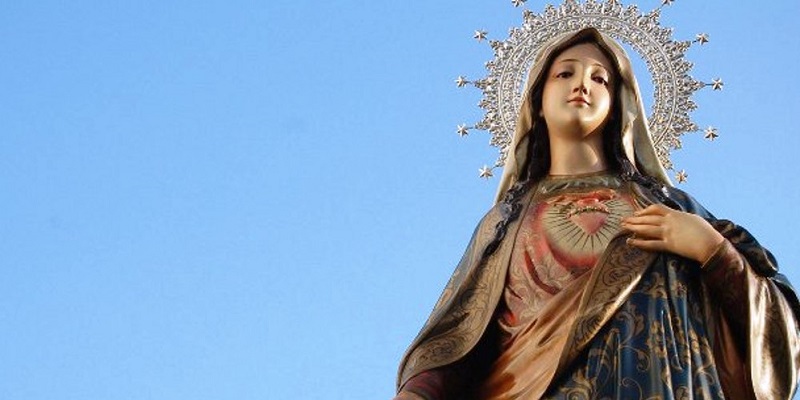
It is a dogma formulated in these words: “The Immaculate Mother of God, the ever Virgin Mary, having completed the course of her earthly life, was assumed body and soul into heavenly glory.” (Apostolic Constitution Munificentissimus Deus)
The Assumption is not in the Bible in an explicit form, but it is necessarily concluded from the Bible. Let us remember that the Bible must be read as a whole (2 Tim 3:16-17), otherwise we will end up making the Bible say what it does not say. That is why we must follow the guidance provided by the Church (2 Pet 1:20-21; 1 Tim 3:15), which received from Christ the grace to teach with authority (“He who hears you hears me, and he who rejects you rejects me; and he who rejects me rejects him who sent me,” Lk 10:16).
First, let us understand that “assumption” is not the same as “ascension.” “Ascension” is the act of ascending to heaven by one’s own power, as Jesus did (Acts 1:3-11). “Assumption” is being taken up to heaven by God himself or by the angels.
1. Is the Assumption of persons biblical?
Persons can be assumed into heaven as Mary was. This was previously the case with Enoch (Gen 5:24) or Elijah (2 Kgs 2:11-12).
Someone will say that with Jesus the gates of heaven are opened, because all had to wait for his coming; but he forgets that the designs of God are not within the reach of men (Wis 17:1; Rom 11:33). The Bible itself says:
“The Lord took Elijah up to heaven in a whirlwind…” (2 Kgs 2:1)
2. Why were persons taken up to heaven?
Because of faith and because they had pleased God throughout their lives (“Enoch walked with God…”, says Gen 5:22). Saint Paul says, so that we may understand the case of Enoch:
“By faith Enoch was taken up so that he should not see death; and he was not found, because God had taken him. Now before he was taken he was attested as having pleased God. And without faith it is impossible to please him, for whoever would draw near to God must believe that he exists and that he rewards those who seek him.” (Heb 11:5-6)
Was this the case with Mary? It was, and to a greater degree.
3. No one like Mary in matters of faith and pleasing God
“Full of grace” the angel Gabriel says to her (Lk 1:28), and he also tells her that God is with her (the marvelous phrase of Lk 1:28 is “Hail, full of grace, the Lord is with you.”); Enoch walked with God, but God was with Mary. God himself, through his messenger, declares her full of grace in a permanent way, for she has found favor with God (Lk 1:30), and Mary accepts the will of the Most High in a totally unconditional way (Lk 1:38). Such is Mary’s state that — before the passion of Jesus Christ — she can declare that God has saved her and that all generations will call her blessed (Lk 1:48). Thus, hers is a case like that of Enoch in the highest degree, for she merited being the Mother of Our Lord (“…you have found favor with God”, says the angel).
It is clear to us, then, that Mary pleases God and is a model of faith, in so splendid a sense that she is already saved from before the passion of Our Lord.
4. In Mary the Lord’s promises are fulfilled
Jesus said to the Sadducees:
“For when they rise from the dead, men and women will neither marry nor be given in marriage, but will be like angels in heaven.” (Mk 12:25)
Saint Paul says:
“Yet for us there is one God, the Father, from whom are all things and for whom we exist.” (1 Cor 8:6)
And elsewhere:
“Our citizenship is in heaven, and from it we await a Savior, the Lord Jesus Christ.” (Phil 3:20)
That is a promise. When Mary visits her cousin Saint Elizabeth, she — filled with the Holy Spirit — declares: “Blessed is she who believed that there would be a fulfillment of what was spoken to her from the Lord!” (Lk 1:45).
To the apostles, Jesus reminds them that he prepares a dwelling for them in the Father’s house:
“Let not your hearts be troubled; believe in God, believe also in me. In my Father’s house are many rooms. If it were not so, would I have told you that I go to prepare a place for you? And when I go and prepare a place for you, I will come again and will take you to myself, that where I am you may be also. And you know the way where I am going.” (Jn 14:1-4)
We therefore have before us the promise of the Resurrection. God had already saved Mary; nothing remained except that, at the end of her life, she should rise immediately. “The Assumption of the Blessed Virgin is a singular participation in her Son’s Resurrection and an anticipation of the resurrection of other Christians” (Catechism, n. 966).
Mary preceded us in heaven and will always precede us, as the mother of the king who sits beside the throne (Ps 45(44):7-10).
Thus, the dogma of the Assumption of Mary is fully biblical.
5. Mary is the New Ark of the Covenant, which had to go up to heaven
The Lord had to enter into his rest, and with Him the ark:
“Arise, O Lord, and go to thy resting place, thou and the ark of thy might!” (Ps 132:8)
That Mary is the New Ark follows from Revelation 11:19 and the text that follows. Saint John says that the sanctuary of God in heaven was opened and he saw the Ark of the Covenant. And what exactly does Saint John see? The woman clothed with the sun, Mary.
“A great sign appeared in heaven: a woman clothed with the sun, with the moon under her feet and a crown of twelve stars on her head.” (Rev 12:1)
John sees Mary in heaven. How does the Bible tell us that she is the new ark of the covenant? Notice what David says when he learned that the Ark was on its way to his house:
“David was afraid of the Lord that day; and he said, ‘How can the ark of the Lord come to me?’” (2 Sam 6:9)
When Mary goes to visit Elizabeth, she — filled with the Holy Spirit — asks in a loud voice:
“And why is this granted me, that the mother of my Lord should come to me?” (Lk 1:43)
Just as David leapt for joy before the Ark (2 Sam 6:14), John the Baptist did so in his mother’s womb when Mary arrived (Lk 1:44). The Ark, after the episode with David, remained three months in that place (2 Sam 6:11), the same length of time that Mary remained in Elizabeth’s house (Lk 1:56).
6. How do we know that Mary was indeed assumed into heaven?
Through the tradition of the Church from the beginnings of Christianity. The traditions of the Church are verified against Sacred Scripture, and in this case of the Assumption we already know that it is a necessary consequence of the Bible.
That the traditions of the Church must be heeded is a biblical command:
“So then, brethren, stand firm and hold to the traditions which you were taught by us, either by word of mouth or by letter.” (2 Thess 2:15)
“I commend you because you remember me in everything and maintain the traditions even as I have delivered them to you.” (1 Cor 11:2; see also Acts 28:17)
This, of course, contradicts the typical thesis of the separated brethren that the Bible is the only source in the things of God, a thesis that has no biblical foundation at all, while, as we have seen, sacred tradition does.
Source: Buscadores del Reino
