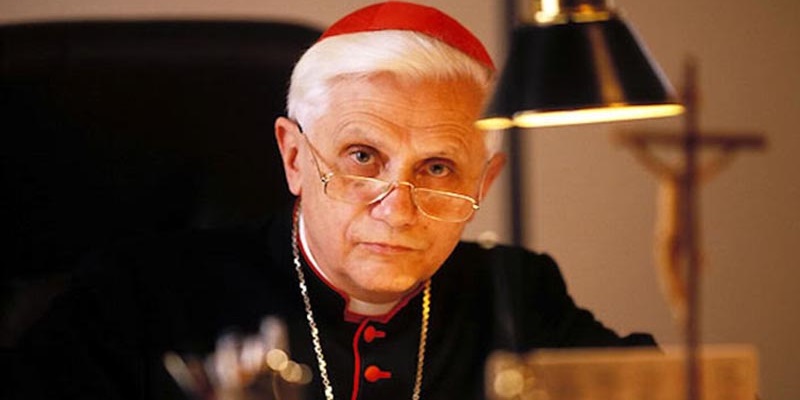
The document responds to religious relativism in ecumenical dialogue, Cardinal Ratzinger says
VATICAN, Sept. 6, 00 (ACI).- Presenting at the Holy See Press Office the declaration “Dominus Iesus” on the unicity and salvific universality of Jesus Christ and the Church, Cardinal Joseph Ratzinger, Prefect of the Congregation for the Doctrine of the Faith, said that the document published by the Dicastery is a necessary response to the religious relativism that places other religions on the same level as Christianity.
Taking part in the presentation of “The Lord Jesus” were Cardinal Joseph Ratzinger, Archbishop Tarcisio Bertone, S.D.B., Msgr. Fernando Ocáriz and Fr. Angelo Amato, S.D.B., respectively prefect, secretary and consultors of the Congregation for the Doctrine of the Faith.
During his illuminating presentation, Cardinal Ratzinger noted that in the lively contemporary debate on the relationship between Christianity and the other religions, the idea is spreading ever more widely that all religions are, for their followers, equally valid ways of salvation”.
“It is —the Cardinal said— an extremely widespread opinion not only in theological circles, but also in ever broader sectors of Catholic and non-Catholic public opinion, especially that most influenced by the cultural orientation prevailing today in the West, which can be defined, without fear of being mistaken, by the word: relativism”.
The Cardinal asked: What is the fundamental consequence of this way of thinking and feeling in relation to the center and core of the Christian faith? It is the substantial rejection of the identification of the singular historical figure, Jesus of Nazareth, with the very reality of God, of the living God”. “In this way, objectively speaking, the erroneous idea is introduced that the religions of the world are complementary to Christian revelation”, he added.
On the basis of such conceptions, Cardinal Ratzinger warned that today to affirm that there exists a universal truth fulfilled in the figure of Jesus Christ and transmitted by the faith of the Church “is considered a kind of fundamentalism that would constitute an attack on the modern spirit and represent a threat to tolerance and freedom”.
The “dogma” of dialogue
“The very concept of dialogue takes on a meaning radically different from that used in the Second Vatican Council”, Cardinal Ratzinger said; and he added that “dialogue, or rather, the ideology of dialogue, replaces mission and the urgency of the call to conversion: dialogue is no longer the path for discovering the truth, the process through which the hidden depth of what the other has experienced in his religious experience is unveiled to him, and which awaits completion and purification in the encounter with the definitive and complete revelation of God in Jesus Christ”.
“Dialogue in the new ideological conceptions, unfortunately introduced within the Catholic world and certain theological and cultural circles, is rather the essence of the relativist ‘dogma’ and the opposite of ‘conversion’ and ‘mission’”, he said.
Thus, the dissolution of Christology and therefore of ecclesiology “becomes the logical conclusion of such relativist philosophy, which paradoxically lies at the basis both of the post-metaphysical thought of the West and of the negative theology of Asia”.
Relativism
“The result —the Cardinal said— is that the figure of Jesus Christ loses its character of unicity and salvific universality. The fact that relativism presents itself, as the banner of encounter with cultures, as the true philosophy of humanity, capable of guaranteeing tolerance and democracy, leads to further marginalizing those who are committed to the defense of Christian identity and to their desire to spread the universal and salvific truth of Jesus Christ”.
“In reality, the criticism of the claim that the revelation of Jesus Christ professed by the Christian faith is absolute and definitive is accompanied by a false concept of tolerance. The principle of tolerance as an expression of respect for freedom of conscience, thought and religion, defended and promoted by the Second Vatican Council and proposed anew by the Declaration, is a fundamental ethical position, present in the essence of the Christian Creed, since it takes seriously the freedom of the decision of faith”; the Cardinal said; but he noted that “this principle of tolerance and respect for freedom is today manipulated and improperly exceeded when it is extended to the evaluation of contents, as if all the contents of the various religions and even of non-religious conceptions of life were to be placed on the same plane, and as if there no longer existed an objective and universal truth, since God or the Absolute would reveal himself under innumerable names, all of them being true”.
“This false idea of tolerance is joined to the loss of and renunciation of the question of truth, which in fact today is considered by many to be an irrelevant or secondary question. Thus the intellectual weakness of current culture becomes evident: when the question of truth is lacking, the essence of religion is no longer distinguished from its “non-essence”, faith is not distinguished from superstition, experience from illusion. Finally, without a serious claim to truth, the evaluation of other religions also becomes an absurdity and a contradiction, since one does not possess the criterion for ascertaining what is positive in a religion and distinguishing it from what is negative or the fruit of superstition and deception”, the Cardinal added.
The duty to evangelize
“Esteem and respect for the religions of the world, as well as for the cultures that have objectively enriched the promotion of human dignity and the development of civilization, do not diminish the originality and unicity of the revelation of Jesus Christ and do not in any way limit the Church’s missionary task”, the Cardinal Prefect explained, noting that “the Church feels herself called, constitutively, to the evangelization of peoples”, even “in the present context, marked by the plurality of religions and the demands of freedom of decision and thought”.
To clarify this reality, the Cardinal concluded, “Dominus Iesus” develops “a twofold task: on the one hand, it presents itself as a renewed authoritative witness to show the world ‘the light of the Gospel of the glory of Christ’ (2Cor 4:4); on the other hand, it indicates as binding for all the faithful the indispensable doctrinal basis that must guide, inspire and orient both theological reflection and the pastoral and missionary action of all Catholic communities throughout the world”.
Doctrinal authority
For his part, Msgr. Bertone spoke at length and with firm precision about the magisterial authority of the document. In this regard, he recalled that, since it was expressly approved by the Supreme Pontiff, it “has universal magisterial nature”, derived “from the fact that the Congregation for the Doctrine of the Faith is the immediate auxiliary body of the Roman Pontiff, with the specific and unique mandate received from him to promote and safeguard throughout the Catholic world the doctrine of faith and morals”.
“If it were denied that the doctrinal decisions of the Congregation, expressly approved by the Pope, are of universal magisterial nature, it would follow that such decisions would have merely orienting and disciplinary value or even a value equivalent to that of a theological opinion, however respectable. This, however, contradicts ecclesial Tradition and the will and mandate of the Supreme Pontiff himself”, the Secretary of the Dicastery said.
The Archbishop further explained that the formula of approval used by the Pontiff, found at the end of the Document, “is of special and elevated authority: certa scientia et apostólica Sua auctoritate. This corresponds to the importance and essential character of the doctrinal contents taught in the Declaration: these are truths of divine and Catholic faith (which belong to the 1st paragraph of the Formula of the Profession of Faith) or truths of Catholic doctrine to be firmly believed (which belong to the 2nd paragraph of the same Formula). The assent therefore requested of the faithful is definitive and irrevocable”.
Msgr. Bertone explained that “a simple but necessary clarification about the degree of authority of the Declaration ‘Dominus Iesus’ is called for, especially considering the insistence with which —also recently— interventions and publications by certain theologians have criticized the Holy Father’s Motu proprio ‘Ad tuendam fidem’ and the doctrinal Note illustrating the Formula of the Profession of Faith, published by the Congregation for the Doctrine of the Faith in 1998”.
The objection of such theologians seeks to establish a distinction between the infallibility of the teaching and the definitiveness of the doctrine. According to some, the doctrinal Note of the Congregation holds that the Magisterium can propose as definitive doctrines that are not taught infallibly. Such theologians conclude that, since they are not infallible, those doctrines could be considered provisional or revisable and therefore open to discussion by theologians.
“This objection, together with its conclusion, is totally unfounded and unmotivated. If a doctrine is taught as definitive, and therefore irreformable, this presupposes that it is taught by the Magisterium with an infallible act, even if of a different typology”, the Archbishop explained.
