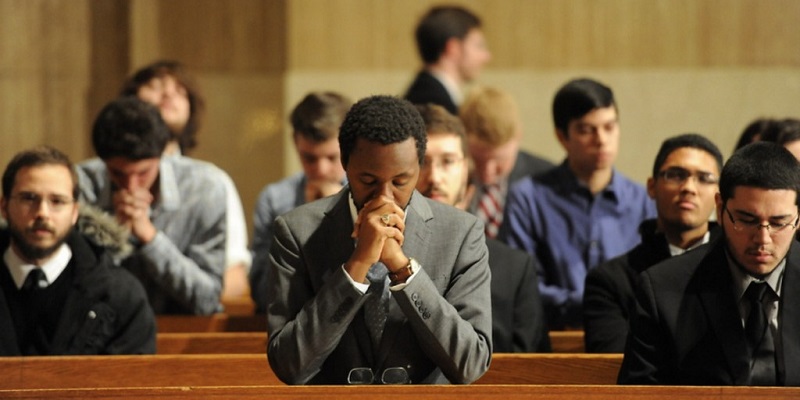
At a meeting, during the question period, one of the participants stood up and asked: “What is the name of the Church of Christ, according to the New Testament?”. The person to whom the question was addressed asked him in turn: “What do you mean?”, since he thought the question was intended to show that the Bible does not use the name “Catholic” for the Church. “Would you say —continued the questioner— that the name of the Church is ‘Church of Christ’?” Certainly —was the answer—, we could call the Church ‘Church of Christ’, since in fact it is his Church”. “Very well —the questioner continued— I am a former Catholic. Now I am a minister of the Church of Christ [a Protestant denomination] that meets on the next block. The very name clearly tells you that ours is the Church of Christ, the true Church“
The speaker did not quite know what to answer, but he was not very impressed by this profound logic… He was going to ask him —though he did not—: “So if we Catholics changed the name of our Church to ‘Church of Christ’, would you say that ours is the Church founded by Jesus Christ?”.
But if it is impossible to know which is the Church of Christ starting from the hundreds of thousands of names of Protestant denominations, then how can we know? (In the 1986 edition of the well-known Protestant reference book “The Christian Source Book” —New York: Ballantine Books— we are told that there are more than 21,000 denominations and sects, according to the latest count, and that some 270 new ones appear annually). Well then, the answer is that we can know which is the Church founded by Christ by examining the characteristics of a particular church. The characteristics that the Catholic Church can offer are the so-called “four marks”.
What is a “mark” (or characteristic)?
Let us keep in mind that the “marks” must have two aspects: First, it must be an outward, visible sign. If it is not something visible it cannot be called a sign; it is not identifiable. It is like the number of the house where one lives: it is useful only if it is on the outside and clearly visible; if the number hangs in one of the rooms of the house, it would no longer be a sign of your house, it would not identify the place where you live. In short, a mark must be evident to everyone; it cannot be hidden “under a bushel” (Mt. 5:15). This is the first aspect of a “mark” of identity.
Second, the “mark” by which we identify something must be essential to that thing; in the case of the Church, something without which the Church would not exist. Miracles, for example, which are a visible characteristic, are not essential to the Church, and therefore are not, strictly speaking, proper “marks” of the Church. Unity, holiness, catholicity and apostolicity, on the other hand, are visible and essential, and these are the four marks of the Church.
How not to present the marks
Before going further, let us recall the wrong way to treat the subject. This kind of reasoning is not sound: “If God founded a Church, it must have been one, holy, catholic and apostolic. Experience shows that the Catholic Church is one, holy, catholic and apostolic. Therefore, she is the Church founded by Christ”.
First of all, it is not evident that God had to found the Church with those four characteristics. Moreover, that syllogism does not prove that other churches cannot also show those marks. At most it proves that, if Christ founded a Church, and if that Church still exists, and if no other church has these four marks, then the Catholic Church is that Church.
A somewhat better argument, although still incomplete, is the following: “Our Lord said that his Church would be one, holy, catholic and apostolic. The Catholic Church is all that; therefore she must be the Church founded by Christ”.
The problem with this argument is that one will have to juggle each of the biblical texts one wants to use to prove it. “Where does Christ say that his Church must be ‘one’, ‘holy’, ‘catholic’ —a word not used in the New Testament to refer to the Church— or ‘apostolic’ —that word does not appear either—?” Besides, this argument might serve for Christians, whereas the mission of the Church is directed to all men, so that the “marks of the Church” must also convince non-Christians.
How to reason with the marks of the Church
We have pointed out the characteristics of the Church, but we have not yet mentioned how they should be used. The correct method of argumentation is the following: Let us begin with the fact that the existence of the Catholic Church is a fact; she exists, something her most hardened enemy would accept (can there be enemies of something nonexistent?). Then consider the four marks as something that all men, taken generally, know or can know. Explain the content of the marks.
First, make the explanation as graphic as possible, for it is not enough merely to mention them: that would convince no one. When you speak to a non-Catholic about the unity or universality of the Church, paint a whole picture of what you mean. Give concrete examples, so that they know what is being discussed.
Do the same when you speak about the holiness of the Church. It is not a matter of scrutinizing the consciences of the people in the Church, something that cannot be done and is beside the point.
One must point out the holiness of the Church’s doctrine (which is not easy to follow, demanding, higher than that of other Churches —one can give as examples Humanae Vitae or Veritatis Splendor, heights to which other churches do not even aspire), the holiness of the means for attaining perfection (the sacraments), and the extraordinary holiness of thousands upon thousands of people, the saints (only in the Church is such fullness of heroic virtues found).
Apostolicity
When dealing with apostolicity, one must point out the uninterrupted, historically demonstrated succession of the bishops of the Catholic Church with respect to the Twelve Apostles, in particular with the bishop of Rome. Emphasize the missionary spirit of the Church in every age, and not only since the nineteenth century, as with the Protestant churches.
If you have made a good description of the marks, there will be no doubt about their existence. Then you will have to prove what they demonstrate.
Miraculous unity
Take another look at unity and catholicity —universality—, which can be considered together. The key here lies in miracles, since these characteristics are precisely miraculous. We could not classify them otherwise: the Church has been one for two thousand years, teaching one single thing.
It is very true that some Christians, taken individually, have damaged that unity in one way or another, often in the manner of sects that separated from the Church. But the Church as such has always remained one, despite the number of individuals who moved away from that unity.
(Note: It is fitting and good to pray for the unity of Christians, but not for the unity of the Catholic Church. The Church has always been united, that is, she has been one. To pray for this unity, as if she had been divided into various branches, is, properly speaking, heretical. To pray for the unity of the Christian churches, which ultimately means nothing other than re-union with the already one Catholic Church, is perfectly appropriate.)
Why did they not disappear?
The catholicity or universality of the Church is something impossible to explain by natural reasons. During nineteen centuries, if the Church had not been miraculously protected by God, she would have had to be destroyed, or even disappear, not once but several times. She would have been stopped before beginning to spread (see Acts 5:34-39).
Her duration and expansion cannot be explained by the fact that she had politically astute popes, for the simple reason that most popes were politically inept. When you speak with a non-Catholic, help him see how superhuman such unity and catholicity must be. (If the person you are speaking with is Protestant, remind him of Matthew 16:19, 28:20, John 14:16).
A chain with no missing links
Then speak about apostolicity. This shows that the Church of today is one with the Church of the Apostles. Explain what the matter is about by pointing out links in that succession, so that your interlocutor knows what it is and what it is not about: it is not necessary to have the documents of every bishop in the world and who consecrated them all the way back to the Apostles. It is enough to have moral certainty that there were no moments in history when that succession did not exist. In general this is a fact that no one disputes, and one that appeals in a particular way to other Christians.
What does the holiness of the Church suggest to us?
The last mark you should speak about is holiness. Show them that the evident holiness of thousands of saints speaks to us of the holiness of the Church, from which they undoubtedly received faith and sanctification.
Note that up to this point you should not have cited the New Testament, for the very good reason that the Church existed before a single letter of the New Testament was written in the Gospels, letters, etc. The same should be said of the marks of that Church: the characteristics of the Church do not depend on the New Testament and cannot be proved by it —they existed before it—, but they can indeed be explained with it.
Although the marks by themselves can be definitive for an atheist, for an “evangelical” Christian it could be useful to end with quotations from Scripture, but one should never begin with them. If you do, you will find yourself in the painful task of explaining the meaning of each text, something you can perfectly avoid if you first clarify the meaning of the marks.
Author: Catholic Answers
Source: Apologetica.org
