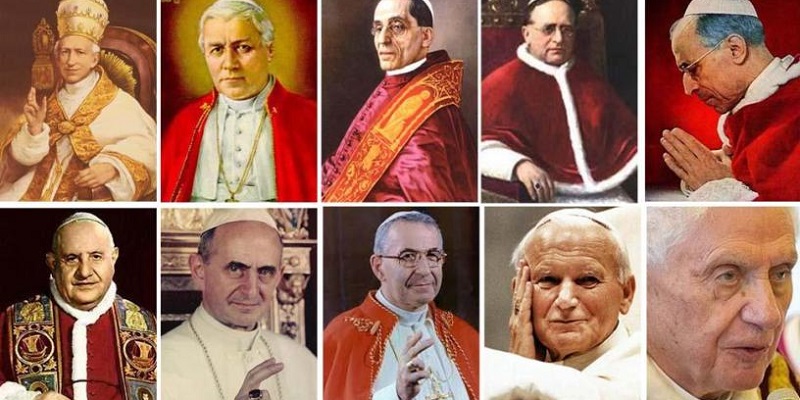
In this article we are called to address a controversial topic for many: the infallibility of the Bishop of Rome, a dogma proclaimed at the First Vatican Council in 1870.
The infallibility of the Bishop of Rome, as head of the apostolic college, assures us and gives us certainty about the authentic Christian faith throughout the centuries, thanks to his succession and his power as Supreme Pastor.
When some Christian doctrine is questioned, it is the Supreme Pontiff who, as supreme pastor of the Church, confirms for us the certainty of what must be held. A doctrine becomes a dogma of faith, as has happened in the Councils throughout the centuries, all approved by a Pope.
Let us see what the Catechism of the Catholic Church says.
869. The Church is apostolic: she is built on a lasting foundation: “the twelve apostles of the Lamb” (Rev 21:14); she is indestructible; she is upheld infallibly in the truth: Christ governs her through Peter and the other apostles, who are present in their successors, the Pope and the college of bishops.
889. In order to preserve the Church in the purity of the faith handed on by the apostles, Christ, who is the Truth, willed to confer on her a share in his own infallibility. By a “supernatural sense of faith” the People of God, under the guidance of the Church’s living Magisterium, unfailingly adheres to this faith.
890. The mission of the Magisterium is linked to the definitive nature of the covenant established by God with his people in Christ. It is this Magisterium’s task to preserve God’s people from deviations and defections and to guarantee them the objective possibility of professing the true faith without error. To fulfill this service, Christ endowed the Church’s shepherds with the charism of infallibility in matters of faith and morals.
891. Tthe Roman Pontiff, head of the college of bishops, enjoys this infallibility in virtue of his office when, as supreme pastor and teacher of all the faithful, who confirms his brethren in the faith, he proclaims by a definitive act a doctrine pertaining to faith or morals.
Now, after having read what the Catechism proposes, we will see how all the arguments given by the Catechism are present in History and that to be in communion with Rome is to have the orthodox faith assured.
Conditions that must be met for a pontifical definition to be Ex Cathedra and therefore infallible (Taken from corazones.org):
1) The Pope must intend to declare a doctrine concerning faith or morals as truth that cannot be changed.2) The Pope must speak as a pastor and doctor of all Christians with the full weight of his apostolic authority (not merely as a theologian or only to the people of Rome).
Within the Christian world, churches and denominations, it has been said that the topic of infallibility is something completely new and that it did not appear in the Apostolic Tradition (falling into the classic evangelical Protestant game “the Council invented it, before that did not exist“), others, even more radical (in their sectarian thinking) have said that it was an effort by the Pope of Rome Pius IX to believe himself infallible.
In the History of the Catholic Church, was it believed that the Chair of Peter had authority in matters of faith and morals and that it kept the apostolic faith?
St. Irenaeus of Lyon year 150 (Disciple of Polycarp and this in turn disciple of St. John the Apostle):
In fact, with this Church (of Rome), because of the greater authority of its origin, every other Church must necessarily agree, that is, the faithful from everywhere; in it has always been preserved for all those who come from everywhere that tradition that starts from the apostles. Against Heresies 3.3.2.
Being in communion with the Church of Rome ensures that we are within the orthodox faith since it preserves the Apostolic Tradition. It is explicitly noted that every church must be alienated from this.
Tertullian, around 200:
Was something hidden from you? to Peter, who was called the stone of the Church that was to be built, that he obtained the keys of the kingdom of heaven and the power of untie and bind in the heavens and on earth?Prescription against heretics 22.2-4
Peter and his successors have the power to bind and loose, as is, and, in agreement with the Jewish rabbis, to correctly decree what the Church requires, that is, the correct way to interpret Apostolic Tradition, which is often questioned.
St. Cyprian of Carthage year 253:
SHowever, to manifest unity he established a chair, and with his authority established that the origin of this unit start with one.It is true that the other Apostles were the same as Peter, adorned with the same share of honor and power, but the principle springs from unity. Peter is given primacy, so that it may be manifested that the Church of Christ is one. On the Unity of the Catholic Church 4.5.
St. Cyprian himself, as bishop, recognizes that in the Chair of Peter emanates not only authority and primacy, but The apostolic faith derives from it. This, due to the context in which St. Cyprian refers to the Unity of the Church that must be in Peter.
Eusebius of Caesarea (260-340):
Peter, the greatest and strongest of all the apostles, and the one who by his life was the spokesperson for everyone else. Ecclesiastical History.2.14.
Eusebius shows historical evidence that Peter was believed to be the spokesman for others, just as the Pope is the Supreme Shepherd who, as spokesman of the Church, confirms his brothers in the faith. This confirmation means that, in the event of any requirement that the Church needs, the Chair of Peter is the spokesperson for the entire Church in communion with it.
All this is before Constantine’s Edict of Milan in 313, for those who say that this emperor created the papacy and like to invent “Constantinian historiography” playing the historian. Now let’s see after this event how the situation of the Chair of Peter of maintaining Unity and Faith does not change.
Saint Hilary of Poitiers (315-367):
and the blessed Simon, that after his confession he holds up the building of the Church and has received the keys to the kingdom of heaven. The Trinity, 6.20.
For this, it is considered that the best and consistent thing, if at the head, which is the chair (Chair) of the apostle Saint Peter, the priests of the Lord inform (or, consult) from each of the provinces. Fragment.2.
Bishops and priests consult or inform the successor of Peter to act in righteousness to the orthodox faith. He, as Supreme Shepherd of the flock, to whom Jesus, our Savior, conferred the keys of the Kingdom to be able to bind and loose.
Saint Ephrem the Syrian (350-370):
I have given you the keys to my kingdom and authority over all my treasures. Homily.4.1.
Once again, the fact of the keys and binding and sed binding is contextualized, within the Jewish people, to the authority they have to correctly interpret Apostolic Tradition and the Scriptures.
Optato De Mileve (367 – 387):
You cannot deny it, that Peter is the first to whom the Episcopal Chair in the city of Rome has been conferred;It is where the chief of the apostles, Peter, who for this reason has been called Cephas, sits. In this unique Chair It is where everyone had to keep the unit, so that the other apostles could not attribute it to each one in their See, and that from now on it would be schismatic and prevaricatory whoever raised another Chair against this unique Chair. From schismate donatistarum.2.
The Chair of tthe Roman Pontiff ensures the Unity of the Church, being a Chair means that it teaches all Christians in the orthodox faith, so that we have no doubt about what we believe.
Saint Ambrose of Milan(337-397):
You are Peter and on this rock I will build my Church… Can’t He (Christ) then? strengthen faith of the man to whom acting with your own authority gave him the kingdom and who called the rock thus declaring it the foundation of the Church? Faith.4.5.
Saint Ambrose declares that the rock, which is Peter, has the duty to strengthen his brothers in the faith by acting with the authority, not conferred by the other bishops, but in that granted to him by the Lord himself when he declared him the foundation of the Church.
but he he was not so anxious as to throw caution to the wind. He called the bishop, and believing that there can be no true gratitude except the spring of true faith, the speaker asks if you agree with the Catholic bishops, that is, with the Church of Rome. The death of Brother Satyrus.1.47.
Saint Ambrose points out that, in case there is any doubt with the bishop, one must be in the “spring of faith” which is to agree with the Church of Rome. That is, the doctrinal authority of Peter’s successor still acts towards the other bishops in communion with him.
St. John Chrysostom, Patriarch of Constantinople (347-407):
He commissioned Peter as a teacher not from a chair, but from the world. Homily.88
Peter was “commissioned,” that is, he was delegated to be the teacher of the World. Likewise, when the Pope declares a dogma as teacher, he is acting as supreme teacher of the Church.
St. Augustine of Hippo (354-430):
Rome has spoken;the case is closed. Sermons 131.10.
Those of you who do not teach that the Roman faith must be kept cannot be believed to keep the Catholic faith. Sermons 120.13.
(Celestio) should keep your nod to the decree of the Apostolic Chair which had been published by his predecessor of sacred memory.The accused, however, refused to condemn the objections made by the deacon, yet he did not dare to openly support the letter of the blessed Pope Innocent. Original Sin.7.8.
The faith of the Roman See is that which discerns Catholic and Orthodox doctrine. That is why St. Augustine declares that if the Supreme Pontiff has spoken, the matter has already been settled. This is the case with dogmatic definitions.
St. John Cassian (Year 360-435):
That great man, the disciple of the disciples, the teacher among teachers, who, exercising the government of the Church of Rome, possessed authority in the faith and in the priesthood. Tell us, therefore, we beg you to tell us, Peter, prince of the apostles, How churches should believe in God. Against Nestorius.3.12.
Here St. John Cassian asks the Bishop of Rome to rule on the heresy of Nestorius, which divided human nature from the divine nature of Christ by affirming that Mary was not the Mother of God, so that Christians follow the orthodoxy to which they must cling. It is as if today someone asked the Pope to speak Ex Catedra to confirm some doctrine of any kind.
Ecumenical Council of Ephesus, year 431:
No one doubts it, but it has been known for all centuries that the holy and most blessed Peter, prince and head of the Apostles, column of faith and foundation of the Catholic Church, received the keys to the kingdom from the hands of our Lord Jesus Christ, savior and redeemer of the human race, and to him has been given the power to bind and loose sins;and him, in his successors, live and judge until now and always.Speech by Philip, Legate of tthe Roman Pontiff, in session III.
Saint Innocent I 5th century.
By seeking the things of God… keeping the examples of ancient tradition… you have truly strengthened… the vigor of your religion, for you approved that the matter should be referred to our judgment, knowing what is due the Apostolic See, as all of us in this place are placed, we wish to follow the Apostle from whom comes the episcopacy itself and all the authority of this name. Following him, We know the same way to condemn the bad as to approve the praiseworthy. And, at least, keeping the institutions of the Fathers as a priestly duty, you do not believe they should be violated, since they; not by human, but by divine sentence they decreed that any matter that was discussed, even if it came from separate and remote provinces, was not to be considered finished until it reached the news of this Headquarters., so that the decision that is fair will be confirmed with all its authority and from here all the Churches will take (as if the waters all came from their first source and through the various regions of the entire world the pure streams flow from an incorrupt source) what they should command, whom they should wash, and whom, as stained with uncleanable silt, they should avoid water worthy of pure bodies. [From Letter 29 In requirendis, to the African bishops, of January 27, 417] (Dz 217).
Pope Innocent I points out that the confirmation carried out by the Roman See, with respect to the churches in communion with him throughout the World, is not by human sentence, but by a divine one of infallible character. It is tthe Roman Pontiff who confirms his brothers in the faith.
Saint Zosimos (417-418):
Even though the tradition of the Fathers has granted so much authority to the Apostolic See that no one dared to dispute its judgment and it did always observe it through the canons and rules, and the ecclesiastical discipline that still prevails has paid in its laws to the name of Peter, from which it itself also descends, the reverence that it owes to him;… thus, Peter being the head of such great authority and having been confirmed by the adhesion of all the elders who have followed it, so that the Roman Church is confirmed bothby human as well as divine laws – and it is not hidden from you that we govern their position and we also have the power of his name, but you know it very well, dear brothers, and as priests you should know it—;nevertheless, We have so much authority that no one can appeal from our sentence, we have done nothing that we have not spontaneously brought to your notice through our letters… not because we were unaware of what should be done, or because we did something that, going against the good of the Church, would be displeasing… [From Letter 12 Quamvis Patrum traditio to the African bishops, March 21, 418] (Dz 221).
Saint Boniface I (418-422):
… To the Synod of Corinth… we have addressed writings by which all the brothers must understand that our judgment cannot be appealed. In fact, it was never lawful to deal again with a matter that had once been established by the Headquarters. Apostolic (Dz 232).[From Letter 13 Retro maioribus tuis to Rufus, bishop of Thessaly, dated March 11, 422]
When the See of Peter establishes something dogmatically, that is, in a way that gives us a certainty of the Truth inspired by Apostolic Tradition and the Scriptures, it is irrefutable since it became an absolute certainty.
Ecumenical Council of Chalcedon, year 451:
This is the faith of the Fathers!This is the faith of the apostles! We must believe it! Anathemas to those who do not believe it! Peter has spoken to us through Leo… This is the true Faith. Council Minutes, Session 2.
Saint Gelasius I (492-496):
Consequently, the first is the See of the Apostle Peter, that of the Roman Church, which has no stain no wrinkle or anything similar. [From the same Letter or Decretal, from the year 495]
Infallibility is not about whether a Pontiff sins, but rather it is about ensuring the absolute certainty of the Christian faith.“He has no spot” could be inferred to the faith maintained through his successors.
Saint Hormisdas (514-523).
Primordial health is to keep the rule of right faith and not deviate in any way from the constitutions of the Fathers. And then the sentence of our Lord Jesus Christ cannot be ignored, which says: You are Peter and on this rock I will build my Church, etc.[Mt. 16, 18], as was said is proven by experience, since in the Apostolic See was preserved always immaculate the catholic religion. (Dz 363).[Memorial of profession of faith, added to the Letter Inter ea quae, to the bishops of Spain, of April 2, 517]
Further We also accept and approve all the epistles of the blessed Pope Leo, who wrote about the Christian religion, as we said before, following the Apostolic See in everything and proclaiming all its constitutions. And therefore, I hope to deserve to find myself in one communion with you, the one that preaches the Apostolic See, in which is the entire, true and perfect solidity of the Christian religion.(Dz 365).[Memorial of profession of faith, added to the Letter Inter ea quae, to the bishops of Spain, of April 2, 517]
Isidore of Seville (560-636):
The decrees of tthe Roman Pontiff, which rest on the supremacy of the Apostolic See, are unquestionableyes. PL.84.
Saint Leo IX 1049-1054
Chap.7…. The Holy Church built on the rock, that is, on Christ, and on Peter or Cephas, the son of Jonah, who was formerly called Simon, because in no way was it to be defeated by the gates of hell, that is, by the disputes of the heretics, who seduce the vain to their ruin. This is what truth itself promises, by which all things are true: The gates of hell will not prevail against it [Mt. 16, 18], and the Son himself testifies that by his prayers he implored from the Father the effect of this promise, when he said to Peter: Simon, Simon, behold, Satan… [Lk.22, 31]. Will there be anyone of such madness who dares to consider the prayer of Him whose will is power to be empty in anything??Have not the inventions of all heretics been reproved and convicted and condemned by the See of the prince of the Apostles, that is, by the Roman Church, now through Peter himself, now through his successors, and now? The hearts of the brothers have been confirmed in the faith of Peter, which until now has not failed nor will it fail to the end?[From the Letter In terra pax hominibus, to Miguel Cerulario and Leo de Acrida, dated September 2, 1053]
Second Council of Lyon 1274.
The Holy Roman Church has the supreme and full primacy and principality over the entire Catholic Church. She truly and humbly acknowledges that she has received this, together with the fullness of power, from the Lord himself in the blessed Peter, prince and head of the Apostles, whose successor is tthe Roman Pontiff. And since she has more than the others duty to defend the truth of the faith, if questions concerning the faith arise, it is by his judgment that these must be defined.
From the profession of faith of the Emperor Michael Palaeologus, read at the second Council of Lyon, session IV, 6 July 1274. 25. Council of Florence, session VI.
This proclamation made by the Greek emperor recognizes that it is the Pontiff, Bishop of Rome, who must defend the truth and even define it.
Pius II (1458-1464)
… By apostolic authority, in accordance with the present, we decree and ordain that none of the predicted friars [Minors or Preachers], shall be lawful from now on to dispute, preach or publicly or privately speak about the aforementioned doubt, namely, whether it is heresy or sin to hold or believe that the same most sacred blood, as stated above, during the triduum of the passion of the same Lord our Jesus Christ, was or was not in any way separated or divided from the same divinity, while it has not been defined by Us and by the Apostolic See how to feel about the decision of this doubt. (Dz 1385) [From the Bull Ineffabilis summi providentia Patris of August 1, 1464]
Here Pius II, Bishop of Rome, explicitly points out that it is the Apostolic See that defines doubt, that is, gives us certainty. This certainty can only be realized and made true thanks to the infallibility of the Supreme Shepherd. We see that centuries before the First Vatican Council there are records of the trust that was had in the Bishop of Rome, as defender of the apostolic faith.
In the criticisms made of the Catholic Church, it is worth noting the classic historical proposal that before the proclamation of the dogma the Bishops of Rome had not spoken Ex Cathedra. In the next point we take into account infallible dogmatic proclamations during the History of the Church.
In History, has Ex Cáthedra been spoken to confirm the faith of the brothers?
1st century. Saint Peter He was also infallible in his office of confirming his brothers. We have two dogmatic proclamations from him. Two Universal Epistles contained in the New Testament.
Saint Leo I Great (440-461). About the Incarnation (against Eutyches)
(3) The property of both natures being safe, then, and both being united in a single person, humility was received by majesty, weakness, by strength, mortality, by eternity, and to pay the debt of our race, the inviolable nature was united to the passible nature. And so—which was appropriate for our remedy—one and the same mediator of God and men, the man Christ Jesus [1 Tim. 2, 5], on the one hand he could die and on the other he could not. In nature, then, complete and perfect of a true man, true God was born, whole in his own, whole in ours.(Dz) [From the Letter 28 dogmatic Lectis dilectionis tuae, to Flavian, Patriarch of Constantinople, June 13, 449]
Saint Agathon 678-681
In fact, we recognize that one and the same our Lord Jesus Christ, the only begotten Son of God, subsists from two and in two substances, without confusion, without commutation, without division and inseparably [cf.148], without the difference of natures being ever suppressed by the union, but rather the property of both natures being preserved and concurring in a single person and in a single subsistence, not distributed or diversified in the duality of persons nor confused in a single composite nature;but we recognize, even after the subsistence union, one and the same only begotten Son, God the Word, our Lord Jesus Christ [v.148] and not one in another, nor one and the other, but the same in the two natures, that is, in divinity and in humanity;because neither the Word changed into the nature of the flesh, nor was the flesh transformed into the nature of the Word. Both remained, in effect, what they naturally were;for only by contemplation do we discern the difference of the natures united in Him, those of which without confusion, inseparably and without commutation He is composed;Only one, in fact, results from one and the other and through one only are both, since together they are both the highness of divinity and the humility of the flesh. Both natures maintain, in fact, even after the union, their property, “and each form works, in communication with the other, what is proper to it: The Word works what belongs to the Word, and the flesh executes what belongs to the flesh. One shines for miracles; another succumbs to insults.”
It follows that, just as we confess that He has truly two natures or substances, that is, divinity and humanity, without confusion, indivisibly, without commutation, so the rule of piety instructs us that the one and the same Lord Jesus Christ [v.254-274], as perfect God and perfect man, he also has two natural wills and two natural operations, since it is shown that this has been taught to us by the apostolic and evangelical tradition, and by the teaching of the Holy Fathers to those received by the Holy Catholic and Apostolic Church and the venerable Councils.
[From the dogmatic letter of Agathon and the Roman Council Omnium bonorum spes, to the emperors]
Benedict XII 1334-1342 Of the beatific vision of God and the very new
Before the resumption of their bodies and the universal judgment, after the ascension of the Savior, our Lord Jesus Christ, to heaven, they were, are and will be in heaven, in the kingdom of heaven and heavenly paradise with Christ, added to the company of the holy angels, and after the death and passion of our Lord Jesus Christ they saw and see the divine essence with intuitive vision and also face to face, without the mediation of any creature that has any reason for the object seen, but by showing them the divine essence immediately andnaked, clearly and patently, and that seeing it in this way they enjoy the same divine essence and that, by such vision and fruition, the souls of those who left this world are truly blessed and have life and eternal rest, and also those of those who will later leave this world, will see the same divine essence and will enjoy it before the universal judgment…
[From the Constitution Benedictus Deus, January 29, 1330]
Eugene IV 1431-1447
We define that this truth of faith be believed and received by all Christians.…that the Apostolic See and tthe Roman Pontiff have primacy over the entire world and that tthe Roman Pontiff himself is the successor of the blessed Peter,… [From the bull Laetentur coeli, July 6, 1439. ] (Dz 694)
Clement XI 1700-1721
1. What else remains for the soul that has lost God and his grace, but sin and the consequences of sin, proud poverty and lazy indigence, that is, general impotence for work, for prayer and for all good work?
2. The grace of Jesus Christ, the effective principle of good of all kinds, is necessary for every good work;Without it, not only is nothing done, but it can’t even be done.3. In vain, Lord, you command, if You yourself do not give what you command.4. Thus, Lord, everything is possible to whom You make everything possible, You working in him.5. When God does not soften the heart by the interior anointing of his grace, exhortations and exterior graces only serve to harden it more.6. The difference between the Jewish and Christian alliance is that in the former, God demands the flight from sin and compliance with the law on the part of the sinner, abandoning him in his powerlessness;but in this, God gives the sinner what he commands, purifying him with his grace.7. What advantage did man have in the Old Covenant, in which God abandoned him to his own weakness, imposing his law on him?But what happiness is it not to be admitted to an Alliance in which God gives us the same thing that he asks of us?8. We do not belong to the New Covenant, but insofar as we participate in its same new grace, which works in us what God commands us.9. The grace of Christ is the supreme grace, without which we can never confess Christ and with which we never deny him.10. Grace is the operation of the hand of omnipotent God, which nothing can prevent or delay.11. Grace is nothing other than the will of omnipotent God who commands and does what he commands.
(Dz 2401-2411)Errors of Pascasio Quesnel [Condemned in the dogmatic constitution Unigenitus, of September 8, 1713″
Pope Pius XII 1939
We pronounce, declare and define to be divinely revealed dogma that the Immaculate Mother of God, always Virgin Mary, fulfilling the course of her earthly life, was assumed body and soul into heavenly glory. ( Dz.3903)
[From the Apostolic Constitution Munificentissimus Deus, November 1, 1950]
Sixtus IV 1471-1484.
Here it is said in the 15th century that the Virgin Mary was Immaculate, that is, without any stain of sin (we will not enter into a biblical debate but we know that in Luke 1:28 Mary is called Kejaritomene which supports that she was in “full grace” like Eve who was created in Grace, that is, Immaculate). Let’s read what the historical sources say.
When, investigating with devout consideration, we scrutinize the exalted prerogatives of the merits with which the queen of heaven, the glorious Virgin Mother of God, raised to the eternal thrones, shines like a morning star among the stars…: A worthy thing, or rather a due thing we consider, to invite all the faithful of Christ with indulgence and forgiveness of sins, to give thanks to the omnipotent God (whose providence, looking abeternal humility of the same Virgin, with preparation of the Holy Spirit, constituted the habitation of her Only Begotten, to reconcile with its Author human nature, subject by the fall of the first man to eternal death, taking from it the flesh of our mortality for the redemption of the people and remaining, however, after childbirth, a virgin without stain), give thanks, we say, and praise for the wonderful conception of the same immaculate Virgin and say, therefore,masses and other divine offices instituted in the Church and to attend them, so that with this, through the merits and intercession of the Virgin herself, they become more suitable for
divine grace.[From the Constitution Cum praeexcelsa, of February 28, 1476]
In truth, despite the Roman Church celebrating the solemn public feast of the conception of the immaculate and always Virgin Mary and having ordained a special and proper office for this purpose, we have known that some preachers of various orders have not been ashamed to publicly affirm until now in their sermons to the people in various cities and lands, and every day they do not cease to preach it, that all those who believe and affirm that the immaculate Mother of God was conceived without a stain of original sin, commit mortal sin, or that they areheretics celebrating the office of the same immaculate conception, and who, hearing the sermons of those who affirm that she was conceived without that stain, seriously sin… We, by apostolic authority, in accordance with the present, reprove and condemn such statements as false, erroneous and totally foreign to the truth and equally, on that point, the books published on the subject… [but those who] dare to affirm that those who hold the contrary opinion are also rebuked,namely, that the glorious Virgin Mary was conceived with original sin, they incur the crime of heresy or mortal sin, as it has not yet been decided by the Roman Church and the Apostolic See.. (Dz 1425) [From the Constitution Grave nimis, of September 4, 1483]
Now let’s see when the Bishop of Rome performs the office of infallibility:
Pius IX 1854
“We declare, proclaim and define that the doctrine that maintains that the most blessed Virgin Mary was preserved immune from all stain of original guilt in the first instant of her conception by the singular grace and privilege of omnipotent God, in attention to the merits of Christ Jesus Savior of the human race, is revealed by God and must therefore be firmly and constantly believed by all the faithful.
(Pius IX, Bull Ineffabilis Deus, December 8, 1854)
Conclusion.
Did the Pope invent something new? No. Here he performs his office in “confirming his brothers in the faith,” which assures us as Christians and as Catholics that what we believe is the greatest certainty of Orthodoxy.
We see how throughout the History of Christianity, tthe Roman Pontiff enjoyed, before the First Vatican Council, infallibility as a mechanism to assure the Christian and Catholic world of the certainty of our doctrines. And to close and understand an infallible statement by the Bishop of Rome, we wanted to give the following example:
Blessings.
Author: Andrés Morasso. Graduate in History. Graduate in Education. Professor of History and Social Sciences.
Literature.
Arraiz, José Miguel, The primacy of Peter in History, Part I, www.apologeticacatolica.org/Primado/PrimadoN06.html
Arraiz, José Miguel, Matthew 16:18, the Primate of Peter and the Fathers of the Church, www.apologeticacatolica.org/Primado/PrimadoN09.html Patristic Sources were taken from here.
Backhouse, E.;Tylor C., History of the Early Church, CLIE Publishing http://escrituras.tripod.com/
Jerusalem Bible.
Catechism of the Catholic Church.
Dominicus Denzinger, Heinrich Joseph, Enchiridion Symbolorum or Denzinger,
Etchevarne, Carlos, Parents of the Church I, (Pedagogical Adaptation), www.holytrinitymission.org/books/spanish/padres_iglesia_1.htm
Gutierrez, Francisco, Studying the topic of Sola Scriptura, www.apologeticasiloe.com/Apologetica/ Estudiosndo_el_tema_de_la_Sola_Scriptura.htm
Infallibility http://www.corazones.org/diccionario/infalibilidad.htm
Immaculate Conception of Mary http://www.corazones.org/maria/ensenanza/inmaculada_conc.htm
Keating, Karl Chapter XVIII: Pope Infallibility in Catholicism and Fundamentalism: The attack of “biblical Christians” on “Romanism”, Ignatius Press, 1998. www.apologeticacatolica.org/Primado/Primado10.htm
Marignac, Gonzalo, What do they say about Matthew 16:18? www.apologeticasiloe.com/Apologetica/Que%20dicen%20sobre%20Mateo%2016,18.htm Patristic sources were taken from here.
Quasten, Johannes, Patrology I, Until the Council of Nicaea, BAC, Madrid, 1962 www.holytrinitymission.org/books/spanish/patrologia_j_quasten_1.htm
Quasten, Johannes, Patrology II, The Golden Age, www.holytrinitymission.org/books/spanish/patrologia_j_quasten_2.htm
St. Augustine, Against Mani’s Epistle Called “The Foundation” 4:5-6 www.corazones.org/biblia_y_liturgia/biblia/santos/agustin_biblia_iglesia.htm
St. Augustine, On Baptism against the Donatists.
www.newadvent.org/fathers/1408.htm
St. Augustine, Letters of St. Augustine in www.newadvent.org/fathers/1102.htm
St. Augustine, Sermons of St. Augustine in www.newadvent.org/fathers/1603.htm
Saint Ambrose, Faith. www.newadvent.org/fathers/3404.htm
Saint Ambrose, The death of Brother Satyrus, www.newadvent.org/fathers/3403.htm
Saint Athanasius of Alexandria, Synodal letter for the bishops of Africa, www.newadvent.org/fathers/2819.htm
Saint Athanasius of Alexandria, Against the pagans, www.newadvent.org/fathers/2801.htm
Saint Athanasius of Alexandria, Decrees of the Council of Nicaea, www.newadvent.org/fathers/2809.htm
Saint Basil the Great, The Holy Spirit, www.newadvent.org/fathers/3203.htm
Saint Basil the Great, Commentaries on Saint Basil on www.newadvent.org/fathers/3201.htm
Saint Cyril of Jerusalem, Catechesis of Saint Cyril in www.newadvent.org/fathers/3101.htm
St. Cyprian of Carthage, Letters of St. Cyprian in www.newadvent.org/fathers/0506.htm
Saint Hilary of Poitiers, About the Trinity, www.newadvent.org/fathers/3302.htm
St. Irenaeus, Against the Heretics, www.multimedios.org/docs/d001092/
St. Jerome, Letters of St. Jerome in www.newadvent.org/fathers/3001.htm
St. John Cassian, Against Nestorius, www.newadvent.org/fathers/3509.htm
St. John Chrysostom, Homily on Second Thessalonians, www.newadvent.org/fathers/2305.htm
Saint Leo the Great, Letters of Saint Leo in www.newadvent.org/fathers/3604.htm
Sack, Juan Carlos, Apostolic succession in the New Testament, www.apologeticacatolica.org/Church/LaChurch03.htm
Theodoret of Cyrus, To Pope Leo, Epistle 113. www.newadvent.org/fathers/2707113.htm
Tertullian,Prescriptions against all heresies, www.newadvent.org/fathers/0319.htm
Trevijano Etcheverria, Ramón, Patrology, www.holytrinitymission.org/books/spanish/patrologia_r_trevijano.htm
Taking from patristic works, Apostolic succession in the teaching of the Church fathers, www.apologeticacatolica.org/Church/LaChurch05.htm Patristic Sources were taken from here.
