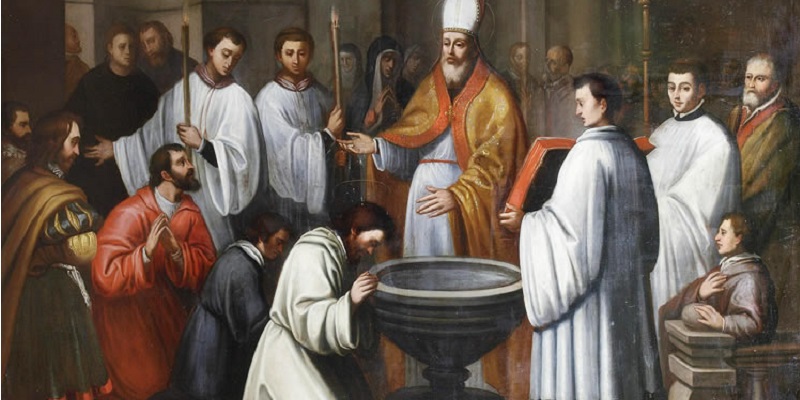
According to the sects in general, the baptism administered in the Catholic Church has no validity, because children have no faith and no sin; furthermore, it is not done by immersion. According to some groups, the Trinitarian formula itself is wrong.
Naturally, these are pretexts and nothing more, as in the other aspects of faith. What is intended is to unsettle unprepared Catholics in order to attract them to their groups.
For us the answer is very simple. Once it is clarified that the Catholic Church is the only Church founded by Christ and will endure until the end of the world, it is impossible for this Church to have been wrong from the beginning on a matter of such importance. Could God have hidden the truth from his Church for so many centuries, and then revealed it to separate groups? Of course not.
Anyway, let’s look at everything calmly.
Adults and children
Here are some fundamental texts:
Go throughout the world and preach the Good News to all creation. He who believes and is baptized will be saved. He who does not believe will be condemned (Mk 16,15-16)
Go and make all the people my disciples. Baptize them in the name of the Father and of the Son and of the Holy Spirit, and teach them to fulfill everything that I have entrusted to them. (Mt 28,19-20).
He who is not reborn of water and the Spirit cannot enter the Kingdom of God. What is born of the flesh is flesh. And what is born of the Spirit is Spirit (Jn 3,5-6).
In these texts we see a difference between Saint Mark, Saint Matthew and Saint John. Saint Mark says that you must first believe and then receive baptism. Saint Matthew and Saint John speak in a more general way. Saint Matthew says that we must baptize and then teach. Saint John says that it is necessary to be born twice to enter the Kingdom of God: the first through the flesh and the second through the Spirit.
Why this difference? Because the Gospel of Saint Mark presents the first stage of Christianity, when it was just beginning and naturally it was necessary to preach first and then baptize those who believed. The problem of the children of Christians did not exist, because there were no Christians yet. This Gospel is the reflection of the first preaching, which we find in the Book of Acts of the Apostles:
Convert and have each of you baptized in the name of Jesus Christ, so that your sins may be forgiven. (Acts 2:38).
Having the obligation to preach, the apostles had to start with the adults. In fact, you cannot preach to children. But, once the parents were converted, did they only have to be baptized, leaving their children without baptism? No. Everyone had to be baptized. In the same book of the Acts of the Apostles, which presents their evangelizing work during the first stage of Christianity, we find something that helps us understand this problem.
They answered him: “Have faith in the Lord Jesus and you and your family will be saved.” And they announced the Word of the Lord to him and to all those in his house. Then the jailer, taking him with him, washed their wounds, and immediately had himself and his entire family baptized. (Acts 16:31-33).
She and her family received baptism (Acts 16:15).
Here it is not said that only adults were baptized. All members of the family were baptized, without any exception. It must be remembered that family meant parents, children, servants and slaves, with their respective children. For this reason we see that in Saint Matthew and Saint John it is not said that one must listen to the preaching first and then receive baptism. In Saint Matthew we see that we must baptize and instruct, in Saint John that it is necessary to be born twice: through the flesh and through the Spirit, without making any distinction between children and adults.
Original sin
When Adam and Eve, our first parents, sinned, they lost the friendship of God, which they had to communicate to their descendants. This sin is called “original” and is transmitted to everyone as an inheritance.
My mother conceived me in sin (Ps 51.5 or 51.7).
One man disobeyed and they all became sinners (Rom 5:19).
Well, through baptism this stain of sin is erased. If one is an adult, all sins are erased: original and actual; if one is a child, only original sin is erased.
Holy Spirit
Apart from removing original sin, baptism gives the Holy Spirit. Otherwise Jesus would not have received baptism, since he had no sin. Therefore, baptism also serves children because it gives them the Holy Spirit.
Well, I baptized you with water, but he will baptize you with the Holy Spirit. (Mk 1,8).
When he came out of the water, the Heavens were rent for him and he saw the Holy Spirit descending on him like a dove. (Mk 1,10).
Entry into the Church
Furthermore, baptism also serves as a door to enter the Church, the new people of God. Otherwise, why did Saint Peter order Cornelius and his family to be baptized, if he had already received the Holy Spirit and therefore his sins had already been forgiven? Through baptism, they became part of the Church.
Then Peter spoke up and said, “Who could deny the water of baptism to those who have received the Holy Spirit, just as we have?” And he commanded them to be baptized in the name of Jesus Christ. (Acts 10:47-48).
Another important point: if the Church is the New People of God, it will have everything: great and small. It doesn’t matter if they understand or not. That is why children are baptized, so that they too can be part of the Church, the New People of God.
The same thing happened in the Old Testament. How did an individual become part of the Ancient People of Israel? Through circumcision. And this was done eight days after being born (Gen 17:2), as they did with Jesus himself (Luke 2:21).
So it makes no sense what members of some sects say: “The infant Baptism is worthless, because children do not understand.”Everything that is done to children is valid. It is worth the medicine that is given to them, the language that is taught to them and the life of God that is communicated to them through baptism.
Baptism in the river?
The true baptism is in the Holy Spirit.
I baptize you with water, but he will baptize you in the Holy Spirit (Mk 1, 8).
Jesus himself was baptized in the Holy Spirit, out of water.
Upon coming out of the water, Jesus had this vision: the heavens were torn and the Holy Spirit descended on him like a dove. (Mk 1,10).
The dove, water or fire are symbols of the Holy Spirit. The apostles themselves were baptized on the day of Pentecost in the Upper Room, without the presence of water. The Holy Spirit was symbolized by fire (Acts 2:1-4).
So those who say that baptism has to be administered in a river are wrong. In fact, on the day of Pentecost, 3,000 people were baptized in Jerusalem, and we know that there is no river in Jerusalem (Acts 2:41). We can also remember the baptism of the eunuch of the queen of Ethiopia, which took place in a place where there was no river, but something like a puddle or well (Acts 8:36-38). Likewise in the case of Cornelius (Acts 10,47-48) and the jailer (Acts 16,33).
The important thing is to baptize. The practical way of performing baptism depends on the time and place. The Bible itself presents different ways of baptizing and Canon Law confirms them: “Baptism must be administered by immersion or infusion, in accordance with the norms of the Episcopal Conference” (c. 854).
Baptism formula
First of all, it is important to understand what it means to baptize someone “in the name of.” It means causing that person to be born again to a new life by being “grafted into” Christ. Well, at the beginning they wanted to emphasize the central role of Christ in the work of salvation. That is why people were baptized in his name. But, little by little, the broader role of the entire Trinity in relation to this work was discovered. And the “Trinitarian formula” was reached:
Go and make disciples of all nations, baptizing them in the name of the Father and of the Son and of the Holy Spirit (Mt 28, 19).
In reality, the expressions that we found before are not true “baptismal formulas”, since they vary from one another. Here they are:
- Acts 2, 38: In the name of Jesus Christ. • Acts 8, 16: In the name of Jesus. • Acts 10, 48: In the name of the Lord Jesus. • Acts 19:5: In the name of the Lord Jesus.
Possibly, at the beginning people were baptized without pronouncing any words. The apostles themselves, on the day of Pentecost, were baptized with the symbol of fire and without any words being spoken. The same probably happened with the three thousand people who were baptized by the apostles on the same day (Acts 2:41) and with the eunuch baptized by Philip (Acts 8:38).
Little by little, some words were added to the external rite, until reaching the definitive formula, which we find in Mt 28:19. And all this under the guidance of the Holy Spirit, always present and active in the Church. Well, what is reprehensible about all this? It is the normal development of any organization or living being.
Some Christian groups, since the beginning of the last century, began to baptize “in the name of Jesus Christ”, citing as a reason the fact that it is an older formula. It doesn’t seem like a valid argument to me. What would happen if someone in your congregation did not accept a current standard because they obeyed an older one? And in relation to our personal development, what would happen to us if we wanted to think and act like when we were children? So, the ideal life would be intrauterine life.
The same thing happens in relation to the formula of baptism and many other aspects of the life of the Church. What is important to know is that Christ founded a Church with the mission of carrying out his work. This Church, assisted by the Holy Spirit, as we can see in the book of the Acts of the Apostles, little by little was structured and organized to carry out its mission.
In the specific case of baptism, furthermore, it is a process approved and sanctioned by a clear text, present in a canonical book. What more do they want? Or do they feel superior to the Church founded by Christ, which for almost twenty centuries used the Trinitarian formula, or to Saint Matthew himself, who saw it well and reported it in his Gospel? Why don’t they use the same principle in relation to the Bible, wanting to live as in the most ancient times, when it was not yet written down?
On the other hand, some groups, which reject the Trinitarian formula, do not even believe in the Trinity. In this case, why argue so much? These would be pure words and nothing more, since for them the Father, the Son and the Holy Spirit constitute the same person with different names. On this note, see “Jesus Only.”
Godparents
In the desire to keep looking for pretexts to attack the Church, some people say: “Where does the Bible speak of godparents? What does godparent mean? Why do Catholics use godparents at Baptism?”
Here is a brief answer about it. Godfather means “Second Father.” The godparents make a commitment to help the parents in the Christian education of their godchildren. In the absence of the parents, the godparents intervene. Well, what is reprehensible about all this? Should we do everything and only what is written in the Bible?
Once again: Jesus commanded baptism. Depending on the places and times, the specific modalities for performing the baptism are established: in the river, in a pool, pouring a little water over the head, with godparents, pastors or teachers, etc.
Testimony of Tradition
Regarding infant Baptism, this is how St. Irenaeus (140-205) wrote:
«Jesus Christ came to save all those who through him are born again for God: infants, children, adolescents, young and old» (Against Heretics, book 2, Chapter 22).
Origen (180-255) affirmed that infant Baptism was instituted by the apostles (Commentary on Romans, book 5, Cap. 9). The Council of Carthage in 253 ordered that newborns be baptized as soon as possible.
Regarding the way of administering baptism, the Didache or Teaching of the Twelve Apostles, which was written contemporaneously with the New Testament (70-100 years after Jesus Christ), says:
«Baptize in the name of the Father, and of the Son, and of the Holy Spirit, in living water. If you do not have living water, baptize with other water. If you can’t do it with cold water, do it with warm water.”Pour water three times on the head in the name of the Father and of the Son and of the Holy Spirit.” (chapter 7).
Author: Fr. Flaviano Amatulli Valente MAP
Source: Evangeliza.com
Michoacán #10 Col.Alvaro Leonel, Yautepec, Morelos, Mexico. CP 62730 Tel: (01777) 3231129 and 3230059 Cell: 1664467
Designer: Lic. Pedro Beltrán Sánchez E-mail: http://mx.geocities.com/beltransanchez/contactanos.htm MSN: grupo_avir@hotmail.com
© The articles from evangeliza.com may be reproduced provided the author and source are cited.
