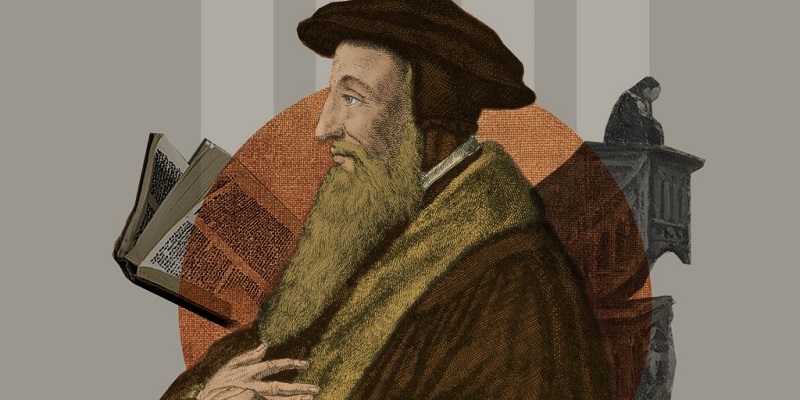
Interesting work of the Protestant reformer John Calvin in defense of infant baptism, taken from his work “Institutes of the Christian Religion”.
Note: We do not identify with Protestant doctrines, nor with Calvinist doctrines, but it is interesting to analyze the following writing to understand the importance that the Reformed Churches gave (and currently give) to the infant baptism.
INSTITUTES OF THE CHRISTIAN RELIGION
By John Calvin
BOOK FOUR
CHAPTER XVI
INFANT BAPTISM IS FULLY IN ACCORD WITH THE INSTITUTION OF JESUS CHRIST AND THE NATURE OF THE SIGN
- Infant Baptism is based on the Word of God
But since certain spirits who are friends of fantasies have promoted great discussions in the Church in our time because of the disposition that we have from God to baptize children, and do not cease to argue, as if God had not ordered this, but that men had invented it now, or at most some time after the apostles, it seems that it will be very good to confirm on this point the conscience of the faithful, and to refute the false objections that such liars can present to subvert the truth of God in thehearts of simple people, who are not prepared to respond to such deceptions and subtleties.
They use an apparently quite acceptable argument; Such is that they only desire that the Word of God be kept and preserved in all its purity and integrity, without adding or subtracting anything, as did those who at the beginning invented the Infant Baptism, without there being any mandate regarding it. We would grant them that this reason is sufficient, if they could prove their purpose that such Baptism is the invention of men, and not the disposition of God. But when, on the contrary, we have clearly demonstrated that they are the ones who falsely and erroneously invent this slander, calling this institution perfectly founded on the Word of God a human tradition, what else will remain but for this pretext, which they invent in vain, to dissolve and turn into smoke?Therefore, let’s see when children began to be baptized. Because if this was a human invention, I confess that it is necessary to leave it and follow the true rule that the Lord has ordained;because the sacraments would be hanging by a thread if they were not based on the pure Word of God. But if we see that children are baptized by the authority of God, let us be very careful not to insult him by disapproving his disposition.
- The promises of Baptism suit children
First of all, it is a doctrine in which all the faithful agree,
that the due consideration of the signs or sacraments that the Lord has left and instituted in his Church does not consist only in the exterior or in the visible ceremonies, but mainly depends on the spiritual promises and mysteries that the Lord has wanted to represent with such ceremonies. For the same reason, whoever wants to know the value of Baptism and to what end it is intended, should not stop merely at the water and the external ceremonies;but must raise its consideration to the promises of God, which are made to us in Baptism, and to the internal and spiritual realities that are represented to us in it. If we come to this, we truly have the substance and truth of Baptism;and here we will come to understand for what purpose the sprinkling of water, which is done in Baptism, has been ordered, and what purpose it serves us. On the contrary, if we do not keep this in mind, and our understanding stops exclusively and only at what is externally executed, we will never understand its virtue, nor how important a thing Baptism is, nor what water means, nor what its use is. We will not deal at length with this, since it is a thing so clear and so common in Scripture, that no Christian can doubt it or ignore it. Therefore, it remains for us to investigate the promises made in Baptism;what are its substance and nature.
Scripture teaches us that the remission and purification of sins, which we achieve through the outpouring of the blood of Christ, is represented to us in Baptism in the first place;and then, the mortification of our flesh, which we achieve by communicating with its death, to resurrect to a new life;that is, in innocence, holiness and purity. With this we understand in the first place that the visible and material sign is nothing but a representation of higher and more excellent things, for the knowledge of which it is necessary that we resort to the Word of God, on which all the virtue of the sign is based. Through it we see that the things meant and represented are the purification of our sins and the mortification of our flesh, to be made participants in the spiritual regeneration that must exist in all the children of God. Furthermore, it shows us that all these things are accomplished in Christ, who is the foundation.
Here, then, in summary, is the declaration of Baptism, to which everything that is said in Scripture can be referred to, except for one point which has not yet been touched upon;namely, that it also serves as a sign and mark by which we confess God before men as our Lord, and we are enrolled and registered among the number of his people.
- Circumcision and baptism. Promises, figures and foundation are the same
Since the people of God before Baptism was instituted used circumcision in its place, it is necessary to see here the difference and convenience that exists between these two signs, to see what one can apply to the other.
When the Lord orders Abraham to be circumcised, he uses these words: that he wants to be his God and the God of his descendants (Gen. 17:7-10), declaring himself Almighty, and showing that in him the abundance and fullness of all goods are given, so that Abraham understands that all his goods come from him. These words contain the promise of eternal life, as Jesus Christ declares when arguing in this regard that his Father is called God of Abraham, to convince theSadducees of the immortality and resurrection of the faithful.”For,” says Christ, “he is not the God of the dead, but of the living” (Luke 20:38). And for this reason Saint Paul, speaking with the Ephesians;and showing them from what ruin God has brought them out, he concludes that they did not have circumcision;who were without Christ, strangers to the promises;without God and without hope (Eph. 2,12);all of which the covenant of circumcision comprised in itself. The first step to draw closer to God and enter eternal life is the remission of sins. From which it follows that this promise corresponds to that of Baptism regarding purification and ablution.
Then the Lord commands Abraham to walk before Him in integrity and innocence of heart;which is nothing other than mortification to resurrect to a new life. And Moses, to remove all doubt as to whether or not circumcision is a sign and figure of mortification, explains it much more extensively in other places, when he exhorts the people of Israel to circumcise their hearts to the Lord, since they were the people that God had chosen among all the nations of the earth (Dt.10, 16; 30,6). Just as God, when adopting Abraham’s posterity as his descendants, commands them to be circumcised, so Moses declares that one must be circumcised in the heart;as if wanting to show what the truth of carnal circumcision is. Likewise, so that no one would think that he could achieve such mortification by his own strength and virtue, Moses teaches that this mortification is the work of God’s grace.
All these things are repeated so much in the prophets that there is no reason to waste time on proofs.
We conclude, therefore, from this, that the fathers had in circumcision the same spiritual promise that we now possess in Baptism;and which meant the remission of sins, and the mortification of the flesh to live in righteousness. Furthermore, as we have taught, Christ is the foundation of Baptism, in which both things reside;and the same is true of circumcision. Because He is the one who was promised to Abraham, and in Him, the blessing of all nations (Gn.12,2);as if the Lord said that the whole earth, cursed in itself, would receive the blessing through Him;in confirmation of which circumcision is given to them as a seal.
- Now it is easy to see the convenience and the difference that exists between the sign of circumcision and that of Baptism.
The promise, in which we have said that the virtue of signs consists, is the same in both;that is, of the mercy of God, of the remission of sins, and of eternal life.
Furthermore, the thing meant is always the same: our purification
and mortification.
The foundation on which the fulfillment of these things rests is also the same in both.
Therefore it follows that there is no difference between baptism and circumcision as to the inner mystery, in which the whole substance of the sacraments consists, as we have shown. The only difference refers to the external ceremonies, which is the least important in the sacraments, since the main consideration depends on the Word and the thing signified and represented.
We can, therefore, conclude that everything that belongs to circumcision also belongs to Baptism, except the external and visible ceremony.
The rule established by Saint Paul directs us to this deduction, that all Scripture must be measured and weighed according to the analogy and proportion of faith (Rom.12, 3.6), which always keeps the promises in mind. And, in fact, the truth at this point can be touched with your hands. Because just as circumcision was a sign and mark for the Jews with which to recognize that God received them as his people and that they had him as their God, serving in this way as a first external entrance into the Church of God, in the same way through Baptism we are first received into the Church of the Lord, to be considered his people, and, for our part, we manifest that we want to have him as our God. Therefore it is clearly seen that Baptism has succeeded circumcision.
- Like circumcision, Baptism belongs to children
And if anyone now asks whether Baptism should be communicated to children, as if it belonged to them by God’s disposition, who will be so foolish and crazy that, in order to solve it, they stop to consider only the visible water, and do not keep in mind the spiritual mystery?For if we keep this in mind, there can be no doubt that baptism is rightly administered to children. When the Lord anciently ordained circumcision for children, he clearly demonstrated that he made them participate in everything that represented them in it. For otherwise it would have to be said that such an institution had been nothing more than a lie, falsehood and deception;just thinking which is a horrible sin. The Lord expressly says that the circumcision administered to the child will serve as confirmation of the covenant we have set forth. If, then, the covenant always remains the same, it is quite certain that the children of Christians are no less partakers of it than those of the Jews were in the Old Testament. And if they participate in the signified reality, why shouldn’t the sign also be communicated to them?If you have the truth, why remove the figure?for the external sign in the sacrament is so united to the Word that it cannot be separated from it.
If it is a question of establishing a difference: between the visible sign and the Word, which of these two things must be held in greater esteem?Evidently, since the sign serves the Word, it is very clear that it is inferior to it;and since the Word of Baptism suits children, why take away the sign, which depends on the Word?If there were no more reason than this, it would be enough to shut the mouths of all those who defend a contrary opinion.
The objection that there was a day appointed for circumcision (Gen. 17:12; 21:4) is not on purpose. It is true that the Lord has not forced us to certain days, as he did with the Jews;but leaving us at liberty in this regard, he has nevertheless declared to us that the children must be solemnly received into his covenant. Do we want something more than this?
- The covenant of grace is also the foundation of Baptism
However, Scripture leads us to even greater Knowledge of the truth. Because it is entirely true that the covenant that the Lord once made with Abraham, saying that he would be his God and that of his descendants, applies no less today to Christians than it formerly did to the people of Israel;and these words are not addressed, less to Christians, than in other times to the patriarchs of the Old Testament. For otherwise it would follow that the coming of Jesus Christ has lessened the grace and mercy of the Father, it being a horrible blasphemy to say or think it.
Just as the children of the Jews were called a holy race, because they were heirs of this covenant, and they were separated from the children of the infidels and idolaters; In the same way, the children of Christians are called saints, even though they are only begotten by a faithful father or mother, and are distinguished from others by the testimony of Scripture (1 Cor. 7:14); Now, the Lord, after having established this covenant with Abraham, wanted it to be sealed in the children with the visible and external sacrament (Gen. 17, 12). What excuse, then, can we allege for not witnessing it and sealing it today the same as it was then?And they cannot reply that the Lord has not instituted any other sacrament to testify this covenant, but that of circumcision, which is now abolished. To this he can very easily respond that the Lord instituted circumcision at that time to confirm his covenant, and that when circumcision was abolished, however, the reason for confirming the covenant always remains;for it suits us as much as it suits the Jews.
Therefore, we must always diligently consider what we agree with them, and what we do not.we differentiate. We agree on the pact and the reason for confirming it; We differ only in the way. They have circumcision for confirmation;we have Baptism in its place. Because otherwise, the coming of Christ would have been the cause of God’s remaining mercy; it would not have been manifested to us as well as to the Jews, if the testimony that they had for their children had been taken away from us.us. If this cannot be said without serious offense to Christ, by whom the infinite goodness of the Father has been more widely and abundantly communicated and manifested to us than ever before, it is necessary to grant that this divine grace should not be hidden any more than it was under the Law, nor should it be less true for us than it was for them.
- Christ receives and blesses children
And for this reason Jesus Christ, to demonstrate that he had come rather to increase and multiply the Father’s graces than to diminish them, graciously receives and embraces the children, who were presented to him, rebuking his apostles, who tried to prevent him, and sought to separate those to whom the kingdom of heaven belonged to him, which is the way (Mt.19,13-14).
Response to three objections. But, perhaps someone will say, what relationship is there between Christ embracing children and Baptism?Because it is not said that He baptized them, but only that He received them, embraced them and prayed for them. Therefore, if we want to follow this example of the Lord, it will be necessary to pray for the children, but not baptize them, because He did not do it.
Let us better consider what Jesus Christ did; Well, we must not let, pass lightly and without further consideration the Lord’s command to present the children to Him;and the reason he later adds: because theirs is the kingdom of heaven. And furthermore, then he actually shows his will, hugging them and praying for them to the Father. If it is reasonable to bring children to Christ, why would it not also be reasonable to admit them to Baptism, which is the external sign through which Jesus Christ declares to us the communion and society that we have with Him?If the kingdom of heaven belongs to them, how can we deny them the sign by which it is opened to us as an entrance into the Church, so that by entering it we may be declared heirs of the kingdom of God?Would we not be very perverse if we cast out those whom the Lord calls to Himself?What if we took away from them what He gives them?What if we closed the door to those who open it?And if it is a question of separating from Baptism what Jesus Christ has done, what is more important, that Christ has received them, has placed his hands on them as a sign of sanctification, has prayed for them, thus demonstrating that they are his;or that we testify with Baptism that they belong to his covenant?
The subtleties they add to escape from this text of Scripture are completely frivolous. Wanting to prove that these children were already adults, by virtue of the fact that Christ says: let them come to me, is evidently repugnant to what the evangelist says, who calls them nursing children; Well, that’s what the words he uses mean. And, therefore, the word come, here simply means to bring closer!This is how those who harden themselves against the truth look for an opportunity to distort things in every word.
The objection is no stronger than that Christ does not say: the kingdom of heaven belongs to children;but: the kingdom of heaven belongs to those who are like children. Because if this were so, what force would Christ’s reason have, that children should approach Him?When he says: let the children come to me, there is no doubt that he understands children in age. And to show that it is reasonable that it should be so, he adds: because of such is the kingdom of heaven. If it is necessary to understand children, it is clear that the term such means: to children and those who are like them belongs the kingdom of heaven.
- Another objection: the apostles did not baptize children
It is, therefore, evident that infant baptism has not been recklessly invented by men, since it is irrefutably confirmed by Scripture.
Nor is there any value in the objection that some make: that it cannot be demonstrated with any text of Scripture that the apostles baptized a single child. Because, even admitting that there is no text that expressly says this, we cannot say that they have not been baptized, since children are never excluded when it is mentioned that a family received Baptism (Acts 16, 15.33). Well, if this reason were valid, we could also conclude from it that women should not be admitted to the Lord’s Supper, since there is no text in Scripture that says that they took communion in the time of the apostles. But in this we follow, as we should, the rule of faith, considering only whether the institution of the Supper suits them;and, if according to the Lord’s intention, it should be administered to them. This is also what we do in Baptism. For when we consider the purpose for which Baptism was instituted, we see that it is no less suitable for children than for adults. And therefore they cannot be deprived of it, without defrauding the intention of the one who instituted Baptism.
As for those who spread among the masses the opinion that for many years after the resurrection of Christ it was not known what it was to baptize children, they certainly lie in this, because there is no writer, however ancient, who does not declare that this Baptism was already used in the time of the apostles.
- Use and fruits of the Infant Baptism
It now remains to demonstrate what benefit the faithful derive from the custom of baptizing their children, and what the children receive when they are baptized: thus no one will despise it as a useless and vain thing. And if anyone attempts to mock Baptism under this pretext, for the same reason he mocks the commandment of circumcision. Because; What can they say against Baptism that cannot also be applied to circumcision?In this way God punishes the arrogance of those who immediately condemn everything that they cannot understand with their carnal sense.
But God has equipped us with better weapons to suppress their crazy foolishness. Because this holy institution by which we feel that our faith is helped with great consolation, cannot be considered superfluous. Because the sign that God communicates to children confirms, as if it were ratified with a seal, the promise that the Lord has made to his people, that He will be their God and that of their descendants for a thousand generations. In which first the goodness of God shines to glorify and exalt his name;and, secondly, to console the faithful man and give him greater courage to give himself totally to God, seeing that he not only cares about himself, but also about his friends.children and their posterity. And it cannot be said that the promise would be enough to ensure the salvation of our children. Because the thought of God has been different, knowing the weakness of our faith, he wanted to strengthen it. Therefore, all those who with full confidence rest in the promise that God wants to show mercy to his descendants, must present their creatures to receive the sign of mercy;and with this he consoles himself and corroborates his faith, seeing with his own eyes the alliance of the Lord sealed in the body of his children.
The benefit that children receive is that the Church, recognizing them as its members, has them in greater esteem;and they; As they grow older, they have the opportunity to lean more towards the service of God, who has manifested himself to them as Father before they had the understanding to understand him, receiving them into the number of his own from the very womb of his mother.
Finally, we must always fear that, if we neglect to mark our children with the sign of the covenant, the Lord will punish us for it (Gen.17,14);because by doing so we renounce the benefit and the mercy it offers us.
- Arguments of the Anabaptists
1st. Circumcision is not comparable to Baptism. Let us now move on to the reasons and arguments with which the evil spirit tries to deceive many with the pretext that they want to base themselves on the Word of God;and let us consider the force of Satan’s subtleties, with which he attempts to invalidate this provision of the Lord, which was always maintained in the Church as it should be.
Those who, impelled by the devil, oppose the Word of God in this matter, seeing themselves caught and convinced by the similarity that we have exposed between circumcision and Baptism, strive to prove that there is a great difference between these two signs, so that they hardly agree at all with each other. They say first that the thing signified is not the same;secondly, that the pact is different;and, finally, that the term children must be understood in different ways.
To prove the first, they allege that circumcision was a figure of mortification, and not of Baptism;which we willingly grant them, since it is in our favor. In fact, to prove our thesis we use no other words but these: circumcision and Baptism equally represent mortification. From which we conclude that Baptism has succeeded circumcision, since Baptism means for Christians what circumcision meant for Jews.
As for the second thing they allege, they show how deranged their understanding is, corrupting and destroying the Scripture with great recklessness;and this not in one place, but in general. Because they present the Jews to us as a carnal and brutalized people;more like beasts than men;with whom God has only established a covenant in order to this temporal life, nor has he made any promise to them other than that of present and corruptible goods. If this were so, what would be left but to consider the Jewish people as a herd of pigs, which the Lord wanted to fatten in the pigsty, and then let them perish forever?Because whenever we mention circumcision and the promises that were made to them, they immediately respond that circumcision was a literal sign, and its promises were carnal.
- 2nd. Circumcision has been nothing more than a literal and carnal sign
Certainly, if circumcision was a literal sign, so is Baptism, since Saint Paul does not consider one more spiritual than the other, when he says that we were circumcised with a circumcision made without hands, by putting off the sinful body of the flesh, in the circumcision of Christ (Col. 2, 11).and then, to clarify this, he adds that by Baptism we are buried together with Christ. What do these words mean, except that the fulfillment and truth of Baptism is also the fulfillment and truth of circumcision, since they appear to be the same thing?Well, he intends to demonstrate that Baptism is the same for Christians as circumcision was for the Jews.
But as I have already clearly demonstrated that the promises of both signs, and the mysteries represented in them, agree with each other, I will not dwell further on it at present. I only want to warn the faithful to consider for themselves whether a sign that does not contain anything that is not spiritual and heavenly should be considered earthly and literal. But as they allege certain passages of Scripture to prove their lie, and thus deceive the ignorant, we will briefly answer the objections they may make to this purpose.
It is a very certain thing that the main promises that the Lord made to his people in the Old Testament, and in which the covenant that he established with him was contained, were spiritual and referred to eternal life. Accordingly, the patriarchs understood them spiritually to conceive the hope of the coming glory, and to feel carried away with affection for it. However, we do not deny that he has expressed his benevolence to them with other carnal and earthly promises;and this to confirm the spiritual promises;as we see that God, after having promised Abraham immortal blessedness, adds the promise of the land of Canaan, to declare his grace and favor towards him (Gen.15, 1-18). In this way all the earthly promises he made to the Jewish people must be understood, putting the spiritual promise before them as the foundation and principle, to which everything else must refer. I treat this here briefly, because I have already explained it at length in the treatise on the Old and New Testaments.
- 3rd. Abraham’s children were his carnal offspring
The difference they establish between the children of the Old Testament and those of the New Testament is that Abraham’s children were then his descendants according to the flesh;but now those who imitate him in faith are called children of Abraham. For this reason, that infancy according to the flesh, which through circumcision entered the covenant, represented the spiritual children of the New Testament, who are regenerated by the Word of God to enjoy immortality. In this there is certainly some glimmer of truth; But these light spirits greatly err when they inconsiderately take the first thing that comes to hand, instead of going forward comparing all things with each other, and not clinging stubbornly to a single word. That is why they cannot help but always grope;and the reason is that nothing has a solid foundation.
We admit that the carnal offspring of Abraham occupied for a time the place of the spiritual children, who by faith are incorporated into him. For we are called his children, although according to the flesh we are not related to him in any way. But if they understand, as their words indicate, that spiritual blessing was never promised to Abraham’s carnal offspring, they are greatly deceived. Therefore, it is better that they point in another direction;namely, that towards which Scripture itself directs us. For the Lord promises Abraham that in his descendants all the people of the earth will be blessed;and at the same time, that He will be their God and that of their posterity. All who receive Christ, the author of this blessing, are heirs of this promise;and that is why they are called children of Abraham.
- And although after the resurrection of Jesus Christ, the kingdom of God has expanded its borders so that all peoples and nations have indifferent entry into it, so that, as He Himself says, the faithful are gathered from all parts of the world and feel in heavenly glory in the company of Abraham; Isaac and Jacob (Mt.8, 11); However, all the time preceding it our Lord had this grace as if enclosed among the Jewish people, and he called it his kingdom, his peculiar people, and his inheritance (Ex. 19, 5). Now, the Lord, to make this favor public, gave them circumcision, which served as a sign by which He declared that He was their God, receiving them under His protection and protection, to guide them to eternal life. Because when God takes us under his protection, what can we lack?
Testimony of Saint Paul. For this reason, Saint Paul, wanting to demonstrate that the Gentiles are children of Abraham exactly the same as the Jews, says thus: Abraham was justified by faith, before being circumcised;later he received circumcision as a sign.of righteousness, that he might be the father of all believers, uncircumcised and circumcised;not of those who boast of circumcision alone, but of those who follow the faith that our father Abraham had in circumcision (Rom. 4:10-12). We see how he equates one to another in dignity. Because Abraham was all the time that God intended, father of the faithful circumcised; But when the wall collapsed, as the Apostle says, to open the door to those who were outside and to enter the kingdom of God (Eph.2, 14), he was made their father, even though they were not circumcised, because Baptism served as circumcision for them. And what the Apostle expressly denies: that Abraham was only the father of those who had nothing else but circumcision, he said it ex professo to undermine the vain confidence of some Jews, who, without paying any attention to piety, were very concerned with mere ceremonies. And the same could be said of Baptism, to refute the error of those who seek nothing else in it but water alone.
- But what does the Apostle mean elsewhere, when he teaches that the true children of Abraham are not those who are according to the flesh, but according to the promise (Rom.9, 7-8)?Certainly from this he wants to conclude that kinship according to the flesh is of no use. But we must carefully consider what the Apostle deals with in this place. Wanting to demonstrate to the Jews that the grace of God is not linked to the descendants of Abraham according to the flesh, and that this kinship in itself does not deserve any esteem, in confirmation of this he adduces, in chapter one;the example of Ishmael and Esau, who, although they were descendants of Abraham according to the flesh, were nevertheless rejected as strangers, the blessing falling on Isaac and Jacob;from which it follows, as he himself concludes, that salvation depends on the mercy of God, which He grants to whomever He pleases;and that, therefore, the Jews have nothing to boast of belonging to the Church of God, if they do not keep the condition of the covenant;namely, if they do not obey his Word. However, after having broken down the vain confidence of the Jews, knowing on the other hand that the covenant established by God with Abraham and his descendants was not in vain, but retained its value and esteem, in the eleventh chapter he declares that “this descendant of Abraham according to the flesh is not to be despised, and that the Jews are the true and first heirs of the Gospel, unless, through their ingratitude, they become unworthy and are left disinherited; but in such a way that theheavenly grace has never completely departed from this nation. That is why the Apostle, although stubborn and rebellious, calls them saints. So great is the honor that he attributes to them because of the holy origin from which they come. As for us, he says, if we compare ourselves with them, we are no more than abortive children of Abraham; And therefore, so that they would not lose their privilege, it was necessary that the Gospel be announced to them first, before any other nation. Because they are the firstborn in the house of God. That is why this honor had to be given to them, until they themselves rejected it and with their ingratitude caused it to be offered to the Gentiles. And no matter how rebellious they may be to the Gospel, we should not despise them, hoping that the goodness of God is still upon them because of the promise. Because Saint Paul declares that he will never depart from them, saying that the gifts and calling of God are without repentance or objection (Rom. 1, 29).
- Conclusion.- Jews and Christians share the benefit of the same covenant
Behold, then, how important is the promise made to Abraham’s posterity. Therefore, although election alone dominates in this regard to differentiate the heirs of the kingdom of heaven from those who are not, nevertheless God wanted to set his eyes particularly on the race of Abraham, and witness to this his mercy, sealed with circumcision. And the same goes for Christians. For just as Saint Paul affirms in one place that the Jews are sanctified because they are of the race of Abraham, so in another passage he declares that the children of Christians are now sanctified by their parents (1 Cor. 7:14);and, therefore, they must be differentiated from the others, who still remain in their impurity. From there it can easily be judged that what they try to conclude is completely false;namely, that the children who were formerly circumcised represented only the spiritual infancy, which proceeds from the regeneration of the Word of God: For the Apostle does not argue so subtly when he writes that “Christ Jesus became a servant of the circumcision… to confirm the promises made to the fathers” (Rom. 15:8). As if to say: Since the covenant made with Abraham also belongs to his descendants, Jesus Christ, in order to fulfill the truth of his Father, has come to call this nation to salvation. This is how Saint Paul understands that the promise must always be fulfilled to the letter, as the words sound, in the descendants according to the flesh, even after the resurrection of Christ. And Saint Peter says the same thing in the second chapter of Acts: he announces to the Jews that the promise belongs to them and their descendants. And in the third chapter he calls them children of the covenant (Acts 3:25), which means heirs (always by virtue of the promise). And this is confirmed by Saint Paul, as we have quoted him;for he places the circumcision of children as a testimony of the spiritual communion they have with Christ (Eph.2,11-l2). If things were as these say, what would they respond to the promise that the Lord makes to his faithful in the Law, to show his mercy to their descendants for a thousand generations?If they resort to allegory, the answer is vain. Or will they perhaps say that the promise is already abolished?This would be to destroy the Law of God, which has rather been confirmed by Christ, insofar as it serves for our good and salvation.
Let us remain firm, then, that the Lord is so good and munificent toward his people that he not only counts them as his people, but also their descendants because of them.
- 4th. Other arguments to differentiate circumcision from Baptism
The other differences which they endeavor to establish between circumcision and Baptism are vain and ridiculous, and contradict each other. Because after affirming that Baptism belongs to the first day of the Christian battle, which is spiritual;and circumcision, on the eighth, after the mortification of the flesh has been completely accomplished, they go on to say that circumcision figures the mortification of sin, and Baptism the burial, after we have died in it.
Certainly a madman would not contradict himself so flagrantly. Because from the first thing they affirm it would follow that Baptism should precede circumcision in time;and of the second, the opposite, namely, that it should be a subsequent series.
We should not be surprised by such contradictions;because the spirit of man, when it gives itself to inventing fables and imaginations similar to dreams, must necessarily fall into such delusions.
If they wanted to see an allegory on the eighth day, they should have proceeded differently. Much better would it have been to state, as the ancients did, that this was to show that the renewal of life depends on the resurrection of Christ, which took place on the eighth day;or, that it is necessary that this circumcision of the heart be perpetual and as long as life lasts!Although there seems to be some reason to believe that the Lord, in deferring circumcision until the eighth day, has taken into account the tender age of the boys; Because the wound in newborns would be more dangerous, and His Majesty wanting his pact to be imprinted on their bodies, it is probable that he established this term, so that they would be strong enough so that their lives would not be in danger.
The second difference they establish is no more solid;for it is a mockery to say that by Baptism we are buried after mortification;because we are rather buried to be mortified, as Scripture teaches (Rom. 6:4).
Finally, they allege that if we take circumcision as the basis of Baptism, we should not baptize girls, since only boys were circumcised. But if you properly consider the meaning of circumcision, you will not be able to say this. Because since the Lord with this sign demonstrated the sanctification of the posterity of Israel, it is entirely true that it served the same for girls as for boys;but the sign did not apply to them because their sex did not admit it. And so the Lord, when ordering that men be circumcised, also included in them the opposite sex, who, not being able to receive circumcision in their own body, participated in a certain way in the circumcision of men.
In conclusion: let us put aside all these crazy fantasies, as they deserve, and let us firmly retain the similarity that exists between Baptism and circumcision in terms of inner mystery, promises, use and efficacy.
- 5th. Children are unable to understand baptism
It also seems to them that they have ample reason for not having children baptized, due to the fact that they do not have the use of reason to understand the mystery that is represented in it;namely, spiritual regeneration, of which children are not capable. From this they conclude that they should be left as children of Adam, until they have reached an age when they are capable of this regeneration.
But the truth of God is very contrary to all this. Because if they must be left as children of Adam, they are left in death;for in Adam there is nothing but death. Christ, on the contrary, commands that they be brought to Him (Mt.19, 14). Because?Because He is life. He wants, therefore, to make them his companions, to give them life. But these fight against their will, telling them to remain in death. For, if they think that children are not lost because they are children of Adam, their error is amply refuted by the testimony of Scripture. By saying that all die in Adam (1 Cor.15:22), it follows that there is no hope of life except in Christ. Therefore, to be heirs of life it is necessary to have part with Christ. Likewise in another place it is said that we are all by nature children of wrath, conceived in sin (Eph. 2, 3), which always brings condemnation with it; Therefore, we must put aside our nature, in order to enter the kingdom of God. And can anything be said more clearly than these words: “flesh and blood cannot inherit the kingdom of God” (1 Cor.15:50)?It is necessary, therefore, that all that is in us perish, in order to be made heirs of God;which cannot take place without being regenerated. Finally, it is necessary for the Word of the Lord to remain true, when it says that He is the life (Jn. 11:25; 14:6). Therefore, it is necessary that we be grafted into Him to be free from the bondage of death.
6th. They cannot be regenerated. But in what way, they argue, are children, who know neither evil nor good, regenerated?To this we respond that, although God’s action remains hidden and incomprehensible to us, it does not mean that we should stop doing it. That the Lord regenerates the creatures he wants to save, as it is entirely true that he saves some, is entirely evident. Because if they are born in corruption, they must be purified before entering the heavenly kingdom, where no defiled thing can penetrate (Rev. 21:27). If creatures are born in sin, as David and Saint Paul declare (Ps. 51:5; Eph. 2:3), they necessarily either remain disgraced by God and the object of his wrath, or they are justified in being pleasing to him. But what do we look for more, when the same heavenly Judge tells us that to enter his kingdom we must be reborn (Jn. 3, 3)?And to shut the mouths of all his friends from murmuring, he offers us an admirable example in Saint John the Baptist, sanctifying him in his mother’s womb (Luke 1:15), and thereby demonstrating that he could do the same with others.
The other loophole they propose is also worthless. They say that God did this once;and it does not follow that it does so with other creatures. We do not affirm such a thing; We simply intend to demonstrate that they, without any reason, want to restrict the virtue and power of God with children;which, however, He has already demonstrated once.
The other subterfuge they resort to is not more solid. They claim that it is a way of speaking of Scripture to say “from the mother’s womb,” instead of from youth. Because it can be seen very well that the angel, when saying these words to Zechariah, did not mean what they intend, but rather that the child, before being born, would be filled with the Spirit. Therefore, let us not try to give laws – to God; Let him sanctify whoever he sees fit, as he did with Saint John, since his hand has not been shortened.
- However, children have a part in the sanctification of Christ
In fact, the reason that Christ was sanctified from his infancy was that all ages, indiscriminately, would be sanctified in Him, as He saw fit. Because in the same way that to destroy the guilt of disobedience that had been committed in our flesh, he clothed himself with this same flesh, in which for our sake and in our name to give fulfilled and perfect obedience; Thus he was also conceived by the Holy Spirit so that he would be completely filled with this holiness and communicate it to us. And if we have in Jesus Christ a most perfect example of all the graces and mercies that God gives to his people, in this also he will serve as proof that God’s hand has not become more shortened for children than for those of another age. Be that as it may, let us be certain that the Lord does not remove any of his elect from this life without first sanctifying him and regenerating him with his Spirit.
To the objection that Scripture knows of no other regeneration than that which takes place from the incorruptible seed by the Word of God (1 Pet. 1:23), we respond that they understand what Saint Peter says very badly;for he addresses only the faithful who had been taught with the Word of God. To these we affirm that the Word of God is the sole and only seed of spiritual regeneration; But we deny that it follows from this that children cannot be regenerated by the virtue and power of God hidden and admirable to us, but easy and common to Him. Furthermore, it would be an unsafe thing to say that the Lord cannot in any way manifest Himself to children.
- 7th. Children can’t have faith
How, they say, can this be, if, as Saint Paul assures, “faith comes by hearing” (Rom. 10:17), and children are incapable of discerning good from evil?
But they do not consider that Saint Paul speaks here only in the ordinary way that the Lord uses to instill faith in his people; Not that he cannot use another, as he certainly does with many, whom, without ever making them hear the Word, he has touched them internally to call them to his knowledge. And since it seems to them that this is repugnant to the nature of children, who, as Moses says, “know neither good nor evil” (Dt. 1:39), I ask them why they want to restrict the power of God, as if he did not know how to do with children what he shortly afterwards does perfectly with them. Because if the fullness of life consists in knowing God perfectly, just as the Lord saves some who die as children, it is true that God has manifested himself to them entirely. And since they are to have this perfect knowledge in the next life, why cannot they have while they live here a glimpse of it, especially when we do not say that God takes away this ignorance from them until he takes them out of the prison of the body?Not that I recklessly want to affirm that children have a faith like the one we have; Our intention is only to show the recklessness and presumption of those who, following their crazy fantasy, affirm and deny whatever they want, without taking into account the reason for doing so.
- 8th. Children cannot regret
To make matters worse, they say that Baptism is a sacrament, as Scripture teaches, of penitence and faith. More like the.children are not capable of this, we must be careful that by receiving them in Baptism we do not make what Baptism means vain and ridiculous.
But these arguments fight more against what God has ordered than against us. Because circumcision was a sign of penitence is seen very clearly in many places in Scripture, mainly in the fourth chapter of Jeremiah. And Saint Paul calls it “the seal of the righteousness of faith” (Rom. 4, 11). Let them ask God why he made it apply to children;because it is the same reason in Baptism as in circumcision. If circumcision was not given to children without reason, Baptism will not be given to them now either. If they resort to the usual subterfuges, namely that children have represented those who truly are children in spirit and in regeneration, this door has already been closed to them.
What we say is, then, this: that if the Lord wanted circumcision – although it was a sacrament of faith and penance – to be communicated to children, there is no problem in Baptism now also being so;unless these slanderers want to accuse God for having so ordered. But the truth, wisdom and justice of God shines in all his works to confuse madness, lies and evil. Because although the children did not understand what circumcision meant, they nevertheless did not stop being circumcised in their flesh for the internal mortification of their corrupt nature, so that they would meditate on it when their age permitted it. In short, this objection is solved in a word by saying that they are baptized into future penitence and faith;of which, although they do not see any appearance when they are baptized, nevertheless the seed of both by a hidden action of the Holy Spirit is planted.
In this way we respond to all the texts referring to Baptism, whose meaning they twist against us. Thus, from what Saint Paul calls it the washing of regeneration and renewal (Tit. 3, 5), they conclude that Baptism should only be given to those who are capable of being regenerated and renewed; To which we replied that circumcision is a sign of regeneration and renewal, therefore it should only be given to those who were capable of the regeneration that it meant; If this were true, God’s command to circumcise boys would be frivolous and unreasonable. Consequently, all the reasons given against circumcision do nothing to harm Baptism.
And they cannot escape by saying that what the Lord has commanded must be taken for granted, and that it must be held to be firm, good, and holy without further investigation into it;which reverence is not due to things that He has not expressly ordained, such as the infant baptism and the like. Because we will easily catch them with our response. God has rightly ordered that boys be circumcised, or not. If He has ordained it in such a way that nothing can be said against it, there will be no harm in baptizing children either.
- So the accusation of absurdity that they try to adduce, we dispel in this way: the children who receive the sign of regeneration and renewal, if they die before reaching the age of discernment to understand it, if they are among the number of the Lord’s elect, are regenerated and renewed by his Spirit in the way that pleases him, according to his virtue and power hidden and incomprehensible to us. If they reach an age where they can be instructed in the doctrine of Baptism, they will understand that throughout their lives they must do nothing but meditate on the regeneration of which they have carried in themselves the sign since their childhood.
In this way we must also understand what Saint Paul teaches, that “we are buried together with (Christ) by baptism” (Rom. 6,4; Col. 2, 12). Because by saying this he does not understand that it must precede Baptism;it only teaches what is the doctrine of Baptism, which can be shown and learned after receiving it, as well as before. Likewise, Moses and the prophets show the people of Israel what circumcision meant, although they had been circumcised in their childhood (Dt.10, 16; Jer.4,4).
Therefore, if they want to conclude that everything that is represented in Baptism must precede it, they are greatly deceived, since all these things were written to people who had already been baptized.
Saint Paul means the same thing when he writes to the Galatians, that when they were baptized they put on Christ (Gal. 3:27). To what end?So that later they would live in Christ, which they had not done. And while older people should not receive the sign without first understanding what it means, the reason is not the same for young children, as we will later say.
What Saint Peter says tends towards the same end, when he affirms that Baptism, which corresponds to Noah’s ark, has been given to us for salvation;not the external washing of the filth of the flesh, but the response of a good conscience toward God, which is through faith in the resurrection of Jesus Christ (1 Pet.3:21). If the truth of Baptism, they say, is the good testimony of conscience before God, when this is not given in it, what will it be, but a vain and unimportant thing?Therefore, if children cannot have this good conscience, their Baptism is nothing but vanity. But they are always deceived by wanting the truth, which is precisely what is signified, to precede the sign without exception. Error that we have already sufficiently refuted. For the truth of circumcision also consisted in the testimony of a good conscience;and if this had necessarily preceded, God would never have commanded the boys to be circumcised. But the Lord Himself teaches that this is the substance of circumcision, and yet.ordering that boys be circumcised clearly shows us that they were granted this for the future.
Therefore, the present truth that we must consider in the infant baptism is that it is a testimony of their salvation, which seals and confirms the covenant that God has established with them. You will understand the other meanings of this sacrament later, when you please the Lord.
- 9th. Rebuttal of other arguments
We will briefly discuss the other reasons that usually arise.
They say that Baptism is a testimony of the remission of sins. I also grant it;and I affirm that precisely for this reason it is appropriate for children. Because being sinners, they need forgiveness and remission of sins. And since the Lord affirms that he wants to be merciful to this tender age, why are we going to prohibit them from the sign of it, which is much less important than the reality it means?and that is why we turn the argument against them and say: Baptism is a sign of the remission of sins;then the sign that follows the thing is communicated to them with all right.
They also allege what Saint Paul says, that the Lord purified his Church in the washing of water by the Word (Eph.5,26). Which is proof against them;because from what the Apostle says we deduce the following argument: if the Lord wants the purification that He works in His Church to be witnessed and confirmed with the sign of Baptism, and children belong to the Church, since they are counted among the people of God, and belong to the kingdom of heaven, it follows that they must receive the testimony of their purification like the other members of the Church. Because Saint Paul, without excluding any person, understands the entire Church in general when he says that Our Lord purified her with the washing of water (Eph. 5:26).
We can also conclude from what they claim, that through Baptism we are incorporated into Christ (1 Cor. 12, 13). For if children belong to the body of Christ, as is clear from what we have said, it follows that it is reasonable that they should be baptized, so that they should not be separated from his body. Behold, with what impetus and strength they fight against us, accumulating texts of Scripture without understanding them.
- 10th. The apostles do not baptize children
Then they want to prove all this by the practice that was followed in the time of the apostles, in which no one was baptized before professing his faith and his penance. Because Saint Peter, they say, asked by those who wanted to convert to the Lord what they should do, answers them to repent and be baptized for the remission of their sins (Acts 2, 37-38). Likewise, when the eunuch asks Philip if he should be baptized, he answers: “If you believe with all your heart, you may well” (Acts 8:37). From this they conclude that baptism is only commanded to those who have faith and penitence;and that he who lacks this should not be baptized.
If this reason is valid, it is seen from the first alleged text that only penance would suffice, since no mention of faith is made in it;and, in turn, for the second, that only faith would be enough, since penance is not required. They will say that one text and another complete each other, and you have to unite them to be able to understand it well. In the same way we also say that to give cohesion to everything we must unite all the other passages that can help resolve this difficulty, since the true meaning of Scripture often depends on the context.
We see, then, that the people who ask what they must do to save themselves are people who are already in the use of reason. Of these we say that they should not be baptized without first giving testimony of their faith and penitence as far as it can be had among men. But children born to Christian parents are not to be counted in this number. That this is so, and not an invention of ours, is seen from the texts of Scripture that confirm this difference. Thus we see that if someone formerly became a member of the people of God, it was necessary that before being circumcised he was instructed in the Law of God and in the covenant that was confirmed with the sacrament of circumcision.
- But the practice of the apostles is in accordance with the doctrine of the covenant
Nor did the Lord, when he made an alliance with Abraham, begin
telling him to be circumcised without knowing why he had to do it, but rather he explains to him the pact that he wants to confirm with circumcision;and after Abraham believed the promise, he then ordered the sacrament to him. Why does Abraham not receive the sign until after he has believed, and instead his son Isaac receives it before he could understand what he was doing?Because man, being already at the age of discernment, before being made a participant in the covenant, must first know what it is and what it consists of. On the other hand, the child begotten by this man, being heir to the same agreement by succession, in accordance with the promise made to the father, is rightly capable of the sign, even if he does not understand what it means. Or to put it more clearly and briefly, since the believer’s child participates in God’s covenant without understanding it, he should not be denied the sign;because he is capable of receiving it without needing to understand it. This is the reason why God says that the children of the Israelites are his children, as if he had begotten them (Ez.16,20; 23,37), since without a doubt he considers himself the Father of all those to whom he has promised to be their God and their descendants. On the other hand, he who is born to unfaithful parents is not counted in the covenant until he is united with God by faith. It is not surprising, then, that the sign is not given;because to do so would be given in vain. That is why Saint Paul says that the Gentiles were without a covenant during the time of their idolatry (Eph. 2:12).
It seems to me that all this matter will be very clear by summarizing it in this way: older people who embrace faith in Christ should not be accepted to receive Baptism before having faith and penance, since they can only open the door to enter the covenant. But the children who are children of Christians, to whom the covenant belongs by inheritance by virtue of the promise; For this reason alone they are suitable to be admitted to Baptism. And the same must be said of those who confessed their faults and sins so that Saint John could baptize them (Mt. 3,6);which example must be followed today;because if a Turk or a Jew should come, we should not administer Baptism to him before we have instructed him and before he has made such a confession as will satisfy the church.
- 11th. Explanation of John 3:5
They also adduced the words of Christ, which Saint John quotes: “Except a man be born of water and the Spirit, he cannot enter the kingdom of God” (Jn. 3, 5). Here we see, they argue, how the Lord calls Baptism regeneration. Since children are incapable of regeneration, how can they be fit to receive the Baptism that cannot exist without it?
Firstly, they are deceived into thinking that this text should be understood as Baptism, because it mentions water. Because after Jesus Christ exposes Nicodemus to the corruption of our nature, and decides that it is necessary for us to be regenerated, just as Nicodemus imagined a second bodily birth, Christ shows him how God regenerates us;namely, in water and in Spirit;as if he said: By the Spirit, who, purifying and watering the souls, does the work of water. So I take the water and the Spirit simply for the Spirit, which is water. This way of speaking is not new, but agrees with that found in Saint Matthew, where John the Baptist says: “He who comes after me will baptize you with the Holy Spirit and fire” (Mt. 3:11). Therefore, as to baptize in the Holy Spirit and fire is to give the Holy Spirit, which has the nature and property of fire to regenerate the faithful, so also to be reborn by water and by the Spirit does not mean anything other than receiving the virtue of the Holy Spirit, which does in the soul the same as water does in the body.
I know that others interpret this passage differently; But I have no doubt that this is the proper and natural meaning of it, since the intention of Christ is none other than that we warn about the need to get rid of our own nature if we want to enter the kingdom of God. Although if I wanted to be subtle in their style, I could reply very well that even if I granted what they say, I would follow that Baptism precedes faith and penitence, since in the words of Christ Baptism is named before the Spirit. There is no doubt that in this passage he does speak about spiritual gifts; If such gifts follow Baptism, I have succeeded in my attempt. But leaving all these subtleties aside, let us be content with the simple interpretation I have given: that no one can enter the kingdom of God until he is regenerated with living water;that is, with the Spirit.
- True regeneration does not depend on Baptism
This also convinces of error those who condemn all those who are not baptized to eternal death. Let us suppose, according to your opinion, that Baptism should not be administered except to adults. What would you say if a boy, properly instructed in religion, died before being baptized?Our Lord says: “He who believes in Him who sent me has eternal life, and will not come into condemnation but has passed from death to life” (Jn.5:24). There is no place where he has condemned those who have not been baptized. I do not want this to be understood as if I were of the opinion that Baptism can be dispensed with without any fear; I only want to demonstrate that it is not necessary that someone who has not received it is not excusable if they had a legitimate impediment. On the other hand, according to their opinion, all of them without exception would be condemned, even if they had faith, with which we possess Christ. And they also condemn all children on whom they do not want to confer Baptism, which they say is necessary for salvation. See now how you can agree with what Christ says: that “of such is the kingdom of heaven” (Mt.19,14). For the rest, even if we grant them everything they ask for in this regard, they cannot conclude anything else from there, if they do not first manage to refute the doctrine regarding the regeneration of children, which we have presented with clear and solid reasons.
12th. Explanation of Mt.28,19. But above all they add as the main basis for their opinion the first institution of Baptism, which, they say, took place, as Saint Matthew relates in the last chapter of his gospel, when Christ said: “Go and make disciples, baptizing them in the name of the Father, and of the Son, and of the Holy Spirit; teaching them to observe all things that I have commanded you” (Mt. 28, 19-20). To which they add what is written in Saint Mark: “He who believes and is baptized will be saved” (Mc.16, 16). Here, they say, is how our Lord commands teaching before baptizing, thereby demonstrating that faith must precede Baptism. In fact, he has demonstrated it with his own example, since he was not baptized until the age of thirty (Mt. 3, 13; Luke 3,23).
In this they are greatly deceived. For it is a manifest error to say that Baptism was instituted here for the first time, when the Lord from the beginning of his preaching commanded his apostles to administer it. There is, therefore, no reason to pretend that the Law and rule of Baptism must be taken from these passages that they quote, as if the first institution of Baptism were contained in them.
But even forgiving them this error, what force can their argument have?Certainly, anyone who wanted to go around with misrepresentations would not lack a way to escape from them. Because, since they insist so much on the order of the words, pretending that as it is said: Go and baptize;and: He who believes and is baptized; It must be concluded that it is first to preach than to baptize, and to believe than to be baptized, why can’t we reply that Baptism must be administered before teaching to keep everything that has been commanded, since it is written: Baptize, teaching to keep everything that I have commanded you?Which we have also noticed in the other sentence of Christ of regeneration of water and Spirit, which I adduced shortly before. Because if they are understood as they please, we must conclude from there that Baptism must precede spiritual regeneration, since it is named first, since the Lord does not say that we must be regenerated from Spirit and water, but from water and Spirit.
- Thus, the argument to which they gave so much importance turns out to be very weak. But we will not stop here, but we will give a firmer and more solid response in defense of the truth;namely, that the chief commandment which the Lord here gives to his disciples is that they preach the Gospel;to which preaching adds the ministry of baptizing, as something subordinate to its main task. Therefore, Baptism is not spoken of here except insofar as it is linked to preaching and doctrine;which can be better understood by exposing things a little more broadly.
The Lord sends the apostles to instruct men, of whatever nation they may be, in the doctrine of salvation. What men?Evidently he only understands those who are capable of receiving the doctrine. Then he continues that these, after having been instructed, be baptized, adding the promise: Those who believe and are baptized will be saved. Is there any mention of children in all this argument?What kind of reasoning is then that these use?: older people must be instructed and must believe before being baptized; it follows, therefore, that Baptism is not suitable for children. No matter how much they torment themselves, they will not be able to deduce from this passage but that the Gospel must be preached to those who are capable of hearing it, before baptizing them, since it is only them that are in question. Therefore, no impediment can be seen in such words to baptize children.children.
- And so that everyone can clearly see their deceptions, I will show you with an example what they are based on.
When Saint Paul says: “If anyone does not want to work, let him not eat” (2 Thess. 3:10), wouldn’t he who would like to conclude from this that children, since they do not work, should not eat, not deserve to have everyone laugh at him?Because?Because what is said about one part, that applies in general to all. Well, these do the same;because what is said about older people is applied to children, making a general rule.
As for the example of Christ, it proves nothing in their favor. They say that Jesus Christ was not baptized before he was thirty years old. It’s true; But the answer is very clear: that then He wanted to begin His preaching, and with it found Baptism, which Saint John had already begun to administer. Wanting the Lord to institute Baptism with his own doctrine, to give greater authority to this institution, he sanctified Baptism in his body;and this when he knew it was more appropriate and convenient;namely, by putting into practice the charge of preaching that had been given to him.
In short: they cannot deduce anything other than that Baptism has its origin in the preaching of the Gospel. And if it seems to you that the term of thirty years must be marked, why do you not observe this, but rather baptize all those whom you think are sufficiently educated?Even Servetus, one of his teachers, who so persistently insisted on being thirty, had already begun to be a prophet at twenty-one. Wonder if it were permissible that a man could boast of being a doctor of the Church before even being a member of it!
- If children are baptized, they must also be admitted to the Supper.
They also object that according to this reason the Supper should be administered to the children, which we want to exclude. As if the difference were not expressly established in Scripture, and with complete clarity!I admit that this was formerly done in the Church, as seen in some ecclesiastical writers, especially in Saint Cyprian and Saint Augustine, but this custom was abolished, and rightly so. For if we consider the nature of Baptism, we will see that it is the first entrance we have to being recognized as members of the Church and counted in the number of the people of God. Therefore, Baptism is the sign of our regeneration and spiritual birth by which we are made children of God. On the contrary, the Supper has been instituted for those who, having already passed from early childhood, are capable of more solid food. This difference is indicated very clearly in the words of the Lord. For Baptism it does not establish any distinction of age;but for the Supper yes, by not allowing it to be communicated except to those who can discern the body of the Lord, who can examine and test themselves, and can announce the death of the Lord (Luke 22, 19), and understand how much his virtue is. Can we wish for anything clearer?: “Let each one prove himself, and so eat of the bread, and drink of the cup” (1 Cor.11:28). It is necessary, therefore, to precede the examination, which children cannot do. And: “He who eats and drinks unworthily, without discerning the body of the Lord, eats and drinks judgment upon himself” (1 Cor.11:29). If only those who prove themselves and are capable of knowing well the holiness of the Lord’s body can participate in the Supper worthily, would it be okay for us to give our children poison instead of the bread of life?What does this command of the Lord mean: Do this in remembrance of me?” What does what the Apostle concludes from here mean: As often as you eat this bread, you will announce the death of the Lord until he comes? What remembrance can we demand from children regarding what they have never understood? How can they announce the death of the Lord, when they do not even know how to speak? None of these things is required in Baptism. Therefore the difference is very great between these two signs; a difference that also existed in the Old Testamentbetween signs similar and corresponding to these. Because circumcision, which evidently corresponds to our Baptism, was applied to children (Gen. 17, 12); but the paschal lamb was not given to everyone indiscriminately, but only to children capable of asking about the meaning of the rite (Ex. 12, 26).
- Refutation of the arguments of Michael Servetus
Although it is annoying for me to make a catalog of so many ramblings, which may be burdensome to the reader, however, as Servetus, one of the main leaders of the Anabaptists, believes that he has provided decisive reasons against the Baptism of infants, it will be necessary to briefly refute them.
1st. It claims that the signs which Christ has given, being perfect, require that those to whom they are given be perfect or capable of perfection. The solution is easy. In vain is the perfection of Baptism limited to a single moment, when it extends and prolongs until death. Even more: it clearly shows its foolishness by demanding perfection in man on the first day he is baptized, when Baptism invites us to it for the entire time of our life, advancing in it every day.
2nd. He objects that the sacraments of Jesus Christ are instituted as a memorial, so that each person remembers that he is buried with Christ. I answer that what he has invented does not need an answer. For the rest, it is very clear from the words of Saint Paul that what Servetus wants to attribute to Baptism refers to the Supper;that is, let each one examine himself (1 Cor.1l,26-28);which is not said of Baptism. From which we conclude that creatures who cannot yet examine themselves are justly baptized.
3rd. To his third argument: that everyone who does not believe in the Son of God remains in death, and that the wrath of God is upon him (John 3:36); And that for this reason the children, who cannot believe, are immersed in condemnation, I answer that Christ does not speak here of the general guilt that affects all the children of Adam, but only threatens those who despise the Gospel;who, with their pride and obstinacy, despise the grace that is offered and presented to them through the Gospel. Now this has nothing to do with children. Furthermore, I oppose a contrary reason: that everything that Christ blesses is free from the curse of Adam and the wrath of God!;Now, we know that he blessed the children;then it follows that they are free from death. He also falsely quotes what is not read in any passage of Scripture: Everyone who is born of the Spirit hears the voice of the Spirit. But, even admitting that it is found written, one cannot conclude from this other than that the faithful are induced to follow God, as the Spirit works in them. Now, it is a serious defect to apply to everyone in general what is said about some in particular.
4th. His fourth objection is that since what is animal or sensual comes first (1 Cor.15:46), we must wait a suitable time for Baptism, which is spiritual. I admit that all the descendants of Adam, being born according to the flesh, have with them their condemnation from their mother’s womb; However, I deny that this prevents God from taking a remedy when it seems good to him. Because Servetus will never be able to demonstrate that there is an appointed term at which spiritual renewal must begin. Saint Paul declares that although the children of the faithful are by nature in the same perdition as others, they are nevertheless sanctified by supernatural grace (1 Cor.7:14).
5th. Then bring an allegory. David, when he went up to the fortress of Zion, did not take with him the blind or the lame, but brave soldiers (2 Sam. 5, 8). But what would Servetus respond if he were confronted with the parable in which God invites the blind and the lame to the heavenly banquet (Luke 14:21)?I also asked him if the lame and maimed had served God first in war. From which it follows that they were members of the Church. But it is superfluous to insist any longer on this, since it is nothing more than a falsehood that he has invented.
Another allegory then follows: that the apostles were fishers of men (Mt.4; 19), and not of children. But I ask you what Christ means when he affirms that all kinds of fish are gathered in the net of the Gospel (Mt.13:47). But since I don’t like to play with allegories, I answer that when the apostles were commanded to preach, they were not prohibited from baptizing children. And I would like you to tell me, since the Greek word used by the evangelist means every human creature, why it excludes children.
6th. He then says that spiritual things must be accommodated to spiritual things (1 Cor. 2, 13);and that not being spiritual children, they are not suitable to receive Baptism. But first of all it is clearly seen that it perversely twists Saint Paul’s text. There it is about doctrine; As the Corinthians took great delight in subtleties and ingenuities, Saint Paul rebukes their negligence for still needing to learn the first rudiments of the Christian religion. Who will dare to conclude from this that children should not be baptized;whom, although begotten according to the flesh, God consecrates and dedicates to himself by a free adoption?
7th. As to the objection that if they are new men, as we say, they must be fed with spiritual sustenance, the answer is easy. Children are admitted into the fold of Christ by Baptism, and this mark of their adoption is sufficient until they grow up and can maintain themselves on solid food;and therefore, we must wait for the time of the examination that God requires for the Supper.
8th. Object later.that Christ invites everyone to his Supper. But it is very clear that Christ admits only those who are already prepared to celebrate the memory of his death. From which it follows that the children, whom he has been pleased to receive into his arms, do not cease to belong to the Church, although they remain in a lower grade until they reach the age of discretion.
To his reply, that it is something monstrous that a man, after being born, does not eat, I reply that souls are fed with other sustenance than the visible bread of the Supper;and, therefore, that Christ does not cease to be bread with which to sustain children, even if they do not receive his visible sign: but that with respect to Baptism the reason is very different;because through him only the doors are opened to enter the guild of the Church.
9th. He also objects that a good steward distributes sustenance to his family in due time and season. I very willingly admit it. But, with what authority and right does it determine a proper moment in Baptism, to prove that children do not have the opportune moment to receive it?
10th. He also adduces Christ’s command to his apostles to hurry up for the harvest, since the fields are already whitening (Jn. 4, 35). With this Christ did not mean anything other than that, seeing the apostles the fruit of their work, they prepared to teach with joy. Who will conclude from this that there is no other convenient and adequate time for Baptism than that of the harvest?
11th. His eleventh argument is that in the early Church all Christians were called disciples (Acts 11, 26), and for this reason children cannot enter their number. But we have already seen how foolishly he argues by elevating what is said in particular to a general law. Saint Luke calls disciples those who had been instructed and professed to be Christians, just as in the time of the Law, the Jews were called disciples of Moses;but no one will conclude from this that the children were strangers, when God had declared that they were his relatives, and has considered them as such.
12th. He also says that all Christians are brothers, and that if we do not give the Supper to children, we do not consider them such. But I return to my principle: that they are not heirs of the kingdom of heaven but those who are members of Christ, and that Christ’s honoring and embracing of children was a true sign of his adoption, through which he has united them to the elders. The fact that they are not admitted to the Supper for some time does not prevent them from being truly members of the Church. Because the thief who was converted on the cross did not cease to be a brother of all the faithful for never having received the Supper.
13th. He then adds that no one is our brother except by the Spirit of adoption, which is only given by faith (Rom. 10, 17). I answer that he does nothing more than always sing the same song, applying without purpose to children what is only said about adults. Saint Paul teaches there that God commonly calls his elect to faith by raising up good doctors, through whose ministry and diligence he extends his hand to them. But who will dare to impose a strange law on God that does not incorporate children into Jesus Christ through another secret path?
14th. The objection that Cornelius was baptized after having received the Holy Spirit is as misguided as trying to make a particular case a general rule. This is seen by the eunuch and the Samaritans (Acts 8,17,38; 10,44), with whom God observed a different order, wanting them to be baptized before receiving the Spirit.15°.The fifteenth reason is very foolish. He affirms that by regeneration we are made gods;and that those to whom the Word of God has been announced are gods (Jn.10, 35), which is not typical of children. Attributing divinity to the faithful is one of his nonsense that I do not want to deal with now. But he acts shamelessly by taking the text of the psalm by the hair, twisting it in a very different sense. Christ says that kings and magistrates are called gods by the prophet, because God has constituted them in their state and dignity. This subtle doctor, what is said in a special way about the office of governing, applies to the doctrine of the Gospel, to expel children from the bosom of the Church.
16th. He also argues that children should not be considered new men, since they are not generated by the Word. But I repeat what I have said so many times: that the doctrine of the Gospel is the seed
incorruptible to regenerate those who are capable of receiving; But as for those who, because of their age, are not capable of being taught, God has his means and ways to regenerate them.
17th. He then returns to the allegories: that the animals under the Law were not offered as newborns (Ex.12, 5). If it is licit to bring figures like this to our mood, I could reply that all the firstborn were consecrated to God as soon as they came out of their mothers’ wombs (Ex. 13:2). From which it follows that to sanctify children we must not wait for them to become adults, but rather they must be dedicated and offered from their birth.
18th. He also insists that no one can come to Christ unless he has been prepared by the Baptist. As if the office of Saint John had not been temporary. But even given this, I affirm that no such preparation took place in the children whom Christ embraced and blessed. Therefore let us not pay attention to it, nor to its false principle.
19th. Finally he cites in his defense Mercury Trismegistus and the Sibyls, according to whom sacred ablutions are only appropriate for elderly people. This is what esteem and reverence he has for the Baptism of Christ, which he wants regulated according to the profane rites of the pagans, in such a way that it is administered as prescribed by Trismegistus, a disciple of Plato. But the authority of God must be of greater esteem to us;and He has been pleased to dedicate the children to Himself, sanctifying them with a solemn sign, the virtue of which they do not yet understand.and we do not believe it is licit to take from the explanations of the Gentiles anything that changes or alters in our Baptism the inviolable and eternal Law of God, which He ordained in circumcision.
20°.In conclusion, he argues in this way: if it is legal to baptize children who lack understanding, the Baptism that children give when they play will also be valid.
Regarding this, let them deal with God, who ordered that circumcision be applied to children as well as adults. And if such has been God’s command, he will be a wretch who under such a pretext wants to disrupt the holy and inviolable institution that God has ordained. But there is no need to marvel that such evil spirits, as if caught up in a frenzy, utter such enormous absurdities to maintain their errors, since God justly punishes their pride and obstinacy with such madness.
It seems to me that I have demonstrated with sufficient evidence how weak are the reasons with which Servetus wanted to help his fellow Anabaptists.
- Conclusion against the Anabaptists
What we have said, I believe, will suffice to demonstrate how without cause and without any reason these people disturb the Church of the Lord by promoting disputes and questions about the Infant Baptism. Therefore it will be well to consider what Satan intends with this cunning. And what he intends is evidently to take away that singular fruit of trust and spiritual joy that the Lord has wanted to give us with his promise, and also to obscure the glory of his name. For how pleasant it is for the faithful to assure themselves, not only with the Word, but also with their own eyes, of…who have achieved so much grace and favor before the Father of mercies, that he not only cares for them, but even, out of love for them, for all their posterity!
Here we can consider how God behaves with us, like a good father of a family, who after our death does not stop taking care of us, and even heals and provides for our children. Should we not, as we consider this, leap for joy like David, so that by this demonstration of his goodness his name may be hallowed?This is why Satan strives so hard to deprive our creatures of the benefit of Baptism; Its purpose is that when the testimony that the Lord has ordered to confirm the graces that he wants to grant us is erased from our consideration, little by little we forget the promise he made us regarding them. From which would arise not only an impious ingratitude towards the mercy of God, but also the negligence in instructing our children in the fear of God, in the discipline of the Law and in the knowledge of the Gospel. Because it is no small incentive for us to educate them in true piety and obedience to God to know that since their birth the Lord has received them into his people, making them members of his Church. Therefore, without rejecting such great liberality from the Lord, let us confidently present to Him our creatures, to whom He has given with His promise entry into the company of those He has established as His family and domestic, who are the Christian Church.
