
My Personal Testimony
This personal testimony outlines my life and the journey from life at the top of Broadway (New York) to street life in Ottawa and my new life in Jesus. (It will take you about 35 minutes to read.)
 The Beginnings
 The Beginnings
I was born the youngest of 4 boys in Overbrook, a poor neighborhood in Ottawa, Canada. My family was not religious at all. I heard many religious notions. My parents baptized me Presbyterian “just in case,” but there was no real practice of the Christian faith. We never went to church. The family was very intelligent and loving, but there was a lot of fighting among us.
No God
No Peace
Knowing God
Knowing Peace
We had no God. On top of that, our neighborhood was a bit rough. There were bikers, suicidal people, a few car bombs, and murderers. A ten-year-old boy stabbed his two younger sisters to death in the house next to ours. Very early on I developed an eating disorder, perhaps in response to the fear I lived in; I would refuse to eat for whole days. My friends were bulking up, but I stayed skinny.
My spiritual emptiness also showed itself in an insatiable thirst for attention. At age 5 I was very, very tiny and funny; everyone would laugh themselves into hysterics and I loved it. Yet this thirst for attention was not good for a boy my size. I took many beatings from the neighborhood bad kids. In one of them they broke my elbow with a hockey stick. He was aiming for my head!
My maternal grandfather was a minister in the United Church (United Church of Canada), and his grandparents had been practicing members of the United Church. My grandmother gave us a Bible (the King James Version), and there was a time when my mom began to read it to me. I loved it but didn’t know why. I was looked after by the Hanlons, a Catholic family; their daughter Claire was my best friend. I would always look at the Cross on the wall of their house, and it drew me in and I would miss it.
One time I fell into ecstasy the moment my older brothers came home carrying a guitar they had bought for $12. Right away I grabbed it and started singing and playing. They looked at each other and said: “He’s good (he plays it well).” I think God gave me that guitar to help me focus. From then on, music was the center of my life. Our family never went to any church.
In 5th grade I saw some kids flying kites in the schoolyard and thought to myself: “I want to learn how to do this.” So I went and bought a kite and started flying it. I wanted it to fly higher and higher. I bought 3,000 feet of string (about 900 meters!). My kite flew higher than everyone else’s. So high that it was a tiny speck in the sky, very hard to see. But I wanted it to fly even higher. I let out so much string that it ran to the end, slipped off the reel, and the kite disappeared. This would later be the story of my life: always going beyond what I could control.
I remember pedaling at the back of a long line of 15 or 20 cyclists on a bike path. I set out to pass them all. I started pedaling hard, and when I had reached 5th place the other bikes began heading the opposite way, and I found myself back at the end of the line again. After 5 to 10 attempts like this (and wearing myself out from the effort), an adult said to me: “Why don’t you just stay behind and enjoy this beautiful sunny day riding your bike, instead of trying to get to the front of the line?” The idea of simply enjoying myself without ‘winning’ was a completely foreign concept to me. Ironically, I was always the scrawniest player on the worst teams in minor-league hockey, rugby, and baseball. That (winning) was not a successful formula for keeping me in check.
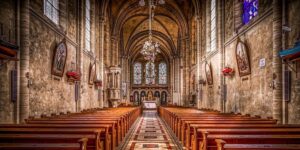 One day I was riding my bike and passed right in front of a church before Sunday Mass. Those were the days when people dressed up to go. I saw one of my schoolmates going in wearing shorts. I laughed at him: “Ha ha, you’re going to church in shorts.” He turned around, looked at me, and answered: “At least I’m going.” The big church doors closed, and I kept circling around on the empty street.
I became religious in my own way after that. I memorized the entire lyrics of “Jesus Christ Superstar.” I now know its content is weak from a scriptural point of view, but in a certain way it taught me the Gospel, and the name of Jesus was enough to give some breath of life to my being. I used to bounce around the house singing: “What’s the buzz, tell me what’s a-happening.”
Sometimes I would wake up in the early morning with knots in my stomach. One night, when I was 10, I woke up and saw a blue neon cross on a church tower through my window. It shone even more brightly through the ice hanging from our roof, and the light came into my room. It was beautiful; the knots in my stomach went away. I think this was my first spiritual experience; after that I began to sing things about Jesus. I made up a little chant that I would sing over and over until it drove my brothers crazy.
I got into a lot of trouble at school and spent a lot of time in the (detention) yard. Once the teacher came out to fetch me from the yard where she had sent me as punishment and said: “David, we’re supposed to follow the orders of our teachers; that’s the way God made us.” I looked at her defiantly and answered: “I don’t believe in God!” I could see her face fall. Without God as a moral reference point, children are uncontrollable—at least I was. The next year a different teacher gave me freedom to do whatever I wanted in class and to sit wherever I wished. That year I won an academic prize at school, but I learned a terrible lesson that would cause me a great deal of misery years later when I grew up: it reinforced in me the idea that I could make up my own rules for living this life.
 Around that time I saw a movie called “War of the Worlds,” based on a novel by H.G. Wells. One scene made an incredible impression on my 11-year-old mind. The aliens were taking over the earth and all of humanity was going to be destroyed. People crowded into a church, crying out to God to save them and interceding. The walls of the church cracked and the roof began to cave in. Suddenly there was silence outside. After a few moments the people hesitantly stepped outside and found all the aliens dead. Bacteria had killed them. The prayers had been heard. I did not know that one day I would come to a church terrified with fear, seeking refuge, when my world was collapsing and the walls of my self-preservation began to crumble to dust.
In grade 7, the school was putting on a play: “Joseph and the Amazing Technicolor Dreamcoat.” I had no idea of the story or the lyrics, but the music teacher asked me to lead the song with 5 girls dancing behind me. The school assembly, a crowd of 800 kids, went wild over the song and “brought the house down” with shouts and applause. It was the first time I experienced that kind of mass acceptance, and from then on I knew I wanted more of that “attention drug” I had discovered. Sadly, I didn’t think much about the words of the Bible story I had sung.
Teenage Mania Strikes

When puberty hit, I gave God a goodbye kiss. Except for a girl I met on a bilingual exchange who gave me a cross, I don’t think I wanted anything to do with it. I had girls, music, alcohol, and marijuana. After a couple of years I took the cross off my neck and replaced it with a “Capricorn” horoscope sign.
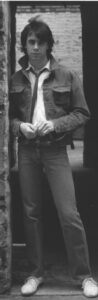
This was a little before I threw away the cross (age 14)
I was a bit of a goofball, but when I had a guitar in my hand… watch out! This is what made me very well known in high school. My parents recognized my talent and arranged private lessons for me in guitar, flute, voice, and piano. My teachers took me to classical music festivals. I got a couple of cassette recorders and began recording the songs I wrote, layering one instrument over another. I practiced 5 hours a day on guitar, flute, and piano. My tie to school was the music room; that was the oasis of my crazy life.
 Talent Show in High School
I also spent a lot of time in the clubs, and I started becoming a very good dancer. Unfortunately, that earned me beatings from some gang members. One night, a guy twice my size followed me out of the club with his gang. He started hitting me over and over until he broke my nose. I managed to break free and run. His gang of 20 guys chased me, meaning to finish me off. I hid in a snowbank. They were all running around looking for me. I was only 10 feet (3 meters) from them, but they couldn’t see me. I couldn’t believe it. I stayed in that snowbank for 2 hours with a broken nose, my face sweating and blood dripping onto the fresh snow. Even when I did not know God, God knew me and was protecting me. I am sure He blinded them, just as I later read in the Bible when the Arameans were confounded after Elisha’s prayer (2 Kings 6:18). Miraculously, a little while after that incident my family bought a house on the other side of the city and I changed schools.
Montreal and the Bahamas
I began playing guitar and singing on the streets of Ottawa. (Look at the flute at my side; it came to be a big part of my musical expression.)
Age 16

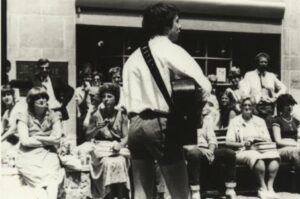
It was on the streets that I really made myself. I learned to draw attention and keep people engaged. A French singer from Montreal, Manuel Tadros, saw me and asked me to join his band. He was very well known, and we played at the great boîte à chansons in Montreal, “Les Deux Pierrots.” He kept becoming better known, and as he grew he became famous as a songwriter and composer as well as an actor in Quebec, writing songs for Roch Voisine and appearing in dozens of movies, TV shows, and commercials.

Les Deux Pierrots, a club that holds 1,500 people in Montreal. I am on the left (age 18), Manuel Tadros (young) is in the center. Claude Foisy on the keyboard. The people of Quebec were a wonderful audience because they could sing and jump at the same time. What now makes me really sad is how Christianity in Quebec fell into oblivion; church attendance dropped to 7%. O Lord, pour out your Grace upon Quebec.
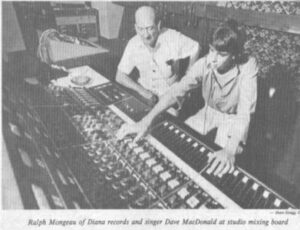
It was around that time that I made my first recording with a small company in Ottawa, Diana Records, owned by Ralph Mongeau. That is where the “good life” began. In the fall of that year I was sent as a soloist to Club Med on Paradise Island, Bahamas. Drink and sex, music and dancing—that was my life at 18.
Club Med, Paradise Island, Bahamas, age 18. I had long since torn the cross off my neck. Vinnie, who was my girlfriend in Ottawa at the time, took this photo. She was very good and sweet, but my ambition won out and I left her. My leaving hurt her immensely. Lack of chastity always breaks hearts. Today she is married to a wonderful man and they have a son.
New York, New York
The New York glamour magazines would take their models to the Bahamas for winter photo shoots. I fell in love with one of them. She invited me to come live with her in her apartment in New York City. A businessman who was there and lived in New York told me: “Yeah? It’ll last two weeks at most. You up for it?” I answered: “No, it won’t be like that; it’s real love.” He gave me his card and said to call him when she threw me out. I said, “It’s real love,” but I took the card.
The night I arrived in New York I was waiting at the front door of the bus terminal with my backpack and my guitar, just like a lost, innocent 19-year-old Canadian. The only thing I noticed was some Puerto Rican guys standing next to me. They started asking me questions like: “Where are you from, bro? How long have you been here?” and so on. Listening to them, I was bracing myself to lose everything I had with me; but one of them said:
“Have you ever heard of the Lord Jesus Christ? Did you know that He has saved us with His blood, and that you can share in it if you are ‘born again’ in Him?”
I let out a deep sigh and felt set free. I was not a believer, but I had never in my life been so glad to see ‘born-again Christians.’ Very politely I excused myself and, relieved, went on my way.
Two days after I moved in with the model, I called the businessman who had given me his card. The model had thrown me out! How had he known what was going to happen?
I began playing in Greenwich Village nightclubs, such as Folk City. There were autographed photos of Bob Dylan, Joni Mitchell, Paul Simon, and many other famous artists who were my gods at the time. I had stars in my eyes. I thought that one day I could become as famous as them, and then I would be happy and my life would be fulfilled. But for now my thing was playing on the streets and in the subway stations. Washington Square Park was a “fantastic” place, full of fun, but I soon realized it was full of ‘wannabe’ musicians (dreamers and hustlers) who, like me, had no money. It even happened that one afternoon I was robbed by a girl I took home after playing in Washington Square. My impure life was beginning to bear fruit. It was only the beginning, a foretaste of what my lack of chastity would come to cost me.
I left the downtown street scene and ended up in Central Park, right off Fifth Avenue, where the moneyed people stroll on weekends and have their picnics. I would play in front of a couple hundred people on the hillside and turn the place into a party. That way I collected good money, and with it I supported myself for a little over two years.
Harlem World: In the World of Rap
One night I rushed to present myself to the executives of an African-American record company from the Harlem scene at a McDonald’s near the Greenwich Village Speakeasy. They invited me to their nightclub called Harlem World on the corner of 116th and Lenox Ave. I went to meet with them. They loved the recording I had brought with me that I had made in Canada. They said to me: “Hey, we’re going to be in the studio tomorrow. Do you want to come and write some horn lines for us?” “Sure,” I answered. I thought I was in the coolest spot in town.
I was waiting for my bus outside the club to head back downtown when suddenly I felt an arm squeezing my neck and I couldn’t breathe. I was thrown to the ground and the guy tried to shove me into an alley. I fought back, and the guy got away with my guitar, my gold chain, and my money. I got up and went back to the club shouting: “They took my guitar! They took my guitar!” “Fat Man,” Jack Taylor, the club owner and a notorious gangster, said: “Get the guy who stole the guitar.” The Harlem World crew immediately sprang into action, working their contacts in the Harlem underworld to find my guitar. Two hours later they came back with my guitar.
They gave me a job as a rap recording producer. We recorded Love Bug Starski’s debut album (real name: Kevin Smith), called “Positive Life,” at the studio ‘The Platinum Factory’ in Bedford-Stuyvesant, Brooklyn. Many rap historians credit Luv Bug Starski with having given Hip Hop its name, because shortly before going to prison he used to play a street dance where he would shout “Hip Hop, ya don’t stop!” The phrase became a “trademark,” and Luv Bug is today considered an “urban legend” of the Hip Hop scene. At that time Luv Bug was getting out of prison and wanted to make rap about the positive side of life rather than about drugs. Amen to that.
In the 18 months I was there I produced Jeckyl & Hide, the Harlem World Crew, Lady “Smiley,” and many others. Many nights I would leave for the studio in Brooklyn at 9 pm and get home at 10:30 AM. A few times I dropped from exhaustion onto the studio floor. I learned to sleep anywhere and to catnap whenever I could. I learned a ton.
Harlem World brought me into contact with top artists of the African-American world, such as “The Mighty Sparrow” and “Eartha Kitt” (Cat Woman). I remember once I was doing the sound for Eartha and jumped onto the stage to adjust things. Suddenly I realized I was out of place and had bounced right off the stage.
Age 20, and innocence had vanished
Cold Crush at Harlem World in the early ’80s. Notice the (mirror) ball above the dance floor.
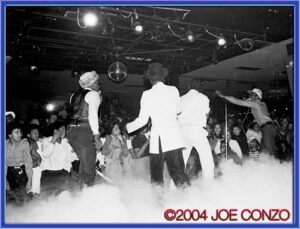
Those were exciting times; break dancing was just beginning to be all the rage in the clubs of Harlem and the South Bronx. Harlem World was the place where the action was. They nicknamed me “Mighty Whitey” (pronounced “Madday Wadday”)—which means something like “powerful little white guy”—and they taught me to break dance. There was free access to tons of cocaine, heroin, and everything you can imagine behind closed doors, but they tried to keep it out of my sight. All the guys had hearts of gold and always looked out for “Mighty Whitey,” so I never had any trouble. They used to sneak up behind me while I danced and crack jokes, because I was kind of a klutz who… obviously danced like a white guy! I got tired of that. Eventually I became a decent dancer, and deep in my soul I knew that Harlem had brought me a step away from the downtown Broadway audition circuit.
In the middle: Steve Negron. I recently found out that Steve found Jesus and converted. In front: DJ “Master Maze.” Unfortunately he chose another path and died at 21 years old from a gunshot wound. Lord have mercy.
The Harlem World Crew (from left to right): Son of Sam, DJ Kool D., Charlie Rock, whose real name is Charles Leake (Charlie taught me to dance electric boogie). Charlie left the nightlife and went to college. Today he is a computer consultant. He recently started producing R&B concerts in New York, featuring some of the great artists of the ’70s such as “The Spinners” and “The Stylistics”
These photos are by Joe Conzo www.joeconzo.com
I must admit that Rap wasn’t what drove me crazy; I liked Soul and R&B much more. I thought Rap would be short-lived, that it would die out in a couple of months, maybe no more than a couple of years at most. (It was 1981. Man, was I ever wrong!) One night at 2 am I was on the 3rd floor of Harlem World with Fat Man and 10 of his guys. I was trying to convince him to go back to the R&B I liked so much more. I got so worked up that I reached the point of saying: “You can take your Rap music and shove it up your…” and I walked out. As I was leaving, I felt 10 furious pairs of eyes fixed on the back of my head. I went downstairs and tried to leave. That is when I realized I had done something really foolish, because if I walked the streets of Harlem at 2 am without a single one of those guys protecting me, I would not last 2 minutes. So I went back up and apologized. They told me I was lucky they had not decided to give me a good beating that night. I was too small and skinny to have such a big mouth. Fat Man, Jack, for some reason, was very, very gentle with me and let me go despite all my arrogance. I think God was watching over me.
I remember looking at a tenement in Harlem that had a big cross on its front. That was their church. I was surprised and amazed by these people who had so much faith that they had turned a half-ruined Harlem tenement into a church. That moved me, but over my feelings for God I chose sex, drugs, and my crazy ambition for fame.
“Fat Man” wanted me to record an album that was going to be called “Mighty Whitey and the Harlem World Crew.” We started recording, but I made the mistake of going to a lawyer on Fifth Avenue who drew up contracts for “white kids” with all kinds of legal provisions. “Fat Man” looked at the contract and said to me: “Hey kid, this isn’t how things work around here.” I simply had not understood the culture. This situation froze our recording deal.
Jack Taylor’s right-hand man was O.C. Tolbert. OC was a great singer, but he sang Soul; he didn’t do Hip Hop, so from waiting so long for his turn to get a recording, he ended up becoming Jack’s bodyguard. I think that underworld had him trapped, but he had a heart of gold. Once, when Jack had stepped out for a moment, I asked him: “O.C., do you want to make a recording?”—because I wanted to produce R&B and not rap. O.C. answered me: “Oh, here he goes.” I went on, “What would you put on the cover of your LP?” He answered: “I want to look really rich—nice clothes, a hat, and chains.” That was the difference between the black kids and the white kids back then. The white singers wanted to dress like poor people, plain and in blue jeans; the black ones tried to look very rich in beautiful white suits. I always heard O.C. do really cool R&B arrangements with his voice, and I tried to imitate him but never could. I was white! Even so, I became a much better singer from being around him.
In a Greenwich Village nightclub I met a white guy, Russ Mason, who was working on making a rap parody called “Prep Rap” about the preppy Ivy League school scene (of rich white kids). He was a tour guide at the NBC studios and knew the producer of “Coast to Coast with Tom Snyder.” We finished the song together and performed it on the show, which aired on NBC. That night the still-unknown “Weird Al Yankovic” made the national debut of “Another One Rides the Bus” on the same show, and that was the start of his career.
The Harlem World guys saw me playing guitar with this white rapper on NBC and got really angry that I was on international TV, and parodying rap on top of it. They called me and picked me up. They took me to Harlem and started asking me questions about the show and about how I had gotten involved with that guy. I can tell you something was going on. They were really beside themselves, and I was in danger. I asked them to let me out of their van, but they wouldn’t. I asked a bunch of times and grew more and more desperate, because their questions kept getting sharper and more aggressive. I was terrified. I can tell you they were about to beat me until I passed out, or maybe worse. Finally, Fat Man said, “Let the kid go,” and that was the end of everything with them. I ended up producing “Prep Rap” for Nemperor/CBS Records, and it had a little spot on Billboard but never took off.
A couple of years later Harlem World was looking for a country guitarist, and they figured that because I was white I would probably be a good country musician. However, I am living proof that not all white guitarists can play country! But I was happy they called me, since it was kind of a way of forgiving me. Fat Man always had a soft spot for guys like me and forgave my arrogance and my selfish ambition.
A year after I left Tayster/Rojac Records, O.C. finally recorded a great song: “I’ve Got It.” He became one of the most important underground R&B singers of the ’80s.
I learned that Jack Taylor died a couple of years later, after a long battle with freebase cocaine. Harlem World closed in 1985, and with that a page in music history was turned. I pray that Fat Man, Jack Taylor, found the Lord before he died. I pray for you, Jack.
O.C. Tolbert went back to Detroit. He turned his life to Jesus at the end of the ’80s. He was able to recover from drugs and became an evangelical preacher-singer. One night in 1995, when he was giving a big revival show, he suffered a heart attack as he came down off the stage and left this life. The last song he recorded was called “Heaven Bound,” produced by Bob Dennis, who in the ’60s had mastered all the Motown songs. The chorus of this song says:
I’m going to Heaven
I’m going to sing and shout
That no one there can cast me out
Because I’m heaven bound
This is for you, O.C. One day we’ll sing soul together in heaven, and then I’ll be able to sing like you. 🙂
Brushing with Death
They say that “the Lord looks after fools and drunks.” I am sure He looked after me. One night in 1982, I was playing guitar and singing in the subway station under Citibank at 53rd and Lexington, as I always did. It had been a good night; I made about $80. I gathered it all up and was heading home around 11 pm. I was alone in the car. Three guys sat down, one on each side and another across from me. They looked at each other and then looked at me. I had a bad feeling; I clutched my guitar and pulled it closer to me, but it was clear the mood was turning ugly and that they were going to rob me. Just at that moment the door connecting the cars at the end of the train opened and a Puerto Rican with a red beret came in. He was literally a “Guardian Angel.” The “Guardian Angels” are a group of young people who ride the subway in groups of 20 to protect the people traveling in the cars. The three guys were twice my size and they had me. One of them patted my head and, very worked up, said to me: “You got lucky this time!”
One day I was stepping off the curb to cross 52nd Street when a bus appeared and stopped so close to me that it brushed my hair, and the wind blew my coat. I was stunned by how close I had been to death.
One day when I was going down to the subway station at 42nd Street, a guy grabbed my arm and asked me for money; I pulled free and kept walking. When I looked back I saw that 7 burly guys were following me. I ran down the stairs; I was certain that if they caught me they would give me a beating, or maybe something worse. When I turned the corner in the terminal, a police officer was standing there. When the guys saw him they veered off to the left and left. Why did God protect me when I didn’t even believe in Him yet? I don’t know.
The First Abortion
I never understood that sex was something sacred according to God’s order and a gift from Him to humans as a means of unity and the generation of life. I understood sex as something you do for fun, as an expression of your feelings toward someone you like and are attracted to. The idea of a lifelong commitment was always outside the focus of my understanding. I was dating a girl I had met when I played in Central Park. After an unexpected pregnancy I “helped” her arrange things to have an abortion. The abortion truly affected her, but we were sure that a baby was not a good thing for us at that time, since she was a student at the American Music & Dramatic Academy (AMDA) and I was in full ascent up the ladder of the entertainment world. We were both crazy for success. Yet it truly affected her. She always carried that loss, even now that she is married and has a child with a famous person who is in the Rock & Roll Hall of Fame—such that if I named her, everyone reading would know who she is. I numbed my pain with my ambition.
The Calls of Broadway and Hollywood
My roommates, whom I split the rent with, were actors. One day they showed me an ad where the “Village Voice” was looking for Rock & Roll singers, actors, musicians, and dancers to work in a Broadway show. The audition got a lot of publicity. So I went to a theater on 42nd Street with my guitar to wait in line for a few hours from the morning, along with 2,000 other souls hoping to reach a moment of glory. When my 2-minute audition finally came, it was around 2 pm. I exploded onto the stage with a blues number and then sang a beautiful ballad. They told me not to leave town. After 6 weeks and 6 callbacks I was hired for a Broadway show doing Mick Jagger, Sting, Alice Cooper, Procol Harum, and the Crewcuts. I also played guitar, flute, and trumpet in the show. I was 21 years old and one of the youngest people on Broadway that season.
For the next 3 years the good life would be my life. I worked with Robert Downey Jr., Christopher Lloyd, and Broadway star Liz Callaway, Jimmy Haslip of the Yellowjackets, and Gary Katz of Steely Dan. I took part in the tour of “Cats,” starred off-Broadway as a co-lead, and played the lead in movies for Paramount, Columbia, ABC TV; I did commercials for Nintendo and Levi’s; I produced music for CBS Records and won the Feature Pick in Billboard Magazine. I was at all the good parties in New York, rubbing shoulders with all the famous people, doing drugs and drinking with them. The agents would tell me, “You’re going to be a star,” and I believed them.
I was hired to act in Playwrights Horizons’ (Off-Broadway) production called “Elm Circle.” At one point in the show I played a “born-again Christian” who was trying to evangelize a girl (the lead) on a train. It was ironic that I played an evangelizer, considering I was an atheist at the time. God was going on ahead. In the play she rejected my evangelization as crazy, almost just like the time I had rejected the two “born-again” guys at Central Station. In the play she was searching for the meaning of life while traveling to Hollywood to become a movie star; yet in the end she would commit suicide. That is how the play ends—a powerful testimony and a true foretaste of what my rejection of God would come to mean for me. Yet I did not get the message.
This is David MacDonald playing Mick Jagger in a show called “Rock & Roll: the First 5000 Years” on Broadway; next to him is Karen Mankes, who would rise to stardom in the “Police Academy” series of films.
Everything was going up and up. Except for one thing: the emptiness I felt inside, which I tried to fill with more and more successes. As I was growing up I had a list of achievements that I thought would make me happy. E.g., being on Broadway, having a beautiful girl, being famous, making money, etc. I thought that if I could have everything on that list, my life would be a dream. After I had checked off every item on the list, however, I still was not happy. That frustrated me. Everything I touched I turned to gold, but nothing was enough. I had a hole inside. I tried to fill it with sex; I was a womanizer. I tried cocaine, drinking, and wild parties. Nothing worked. I did not understand that this hole was a hunger for God.
A little less than a year after the first abortion, I was hired on Broadway for a show called “Baby,” about three couples expecting children. I was the only one on Broadway who knew this topic in detail, and it was the first lead role for Liz Callaway, who played my wife. Now I understand why my subconscious would not let me work on this show. Three days before rehearsals began, I quit to go record a series called “Flashdance” for NBC. The series was shelved, and Todd Graff, who replaced me in “Baby,” was nominated for a Tony for the role I had abandoned. The recorded album is here
Today he is a well-known writer and director. I think it is ironic that after an abortion I was hired for the role of an expectant father in a show called “Baby,” and that I abandoned it in my ambition for even more fame. I moved to an apartment on 14th Street with another actor. He said we had to turn that old, rundown place into a cool bachelor pad. I thought it was a great idea. Two days after I moved in, he went out with his friends to Studio 54 for one of those “crazy” Friday nights. When he came back he found me with the whole wall of my room torn down—the bricks, the plaster, the paint all scattered everywhere. He looked at me in astonishment and said: “This isn’t cool. I’m going to start the repairs…” and he went on and on. I was always very enthusiastic about everything, and it was fine because the friendship was not broken. After several months, my room looked beautiful, and then I had to move because I had been hired for a show. That was the story of my life; I had 23 changes of address in 4 years.
Another Abortion Sets Off the Downward Spiral
I had not learned my lesson. Soon I met a girl who was a doctor and a professional dancer in a well-known dance group. She danced in New York during the fall, spring, and winter, and worked as a doctor in Montreal in the summers. I was very proud of her. One night she told me she was pregnant, even though she was on the pill. We agreed that it was inconvenient to have a baby because we were “building our careers,” and we aborted it.
Although she too wanted the abortion, once in the operating room, the moment the doctor began using the suction machine to remove the pieces of our baby, she began to scream frantically: “Get that out!” It was emotionally devastating for her. Neither all her medical training nor her glamorous success in dance could pull out her emptiness. With all her education, her brilliance as a dancer, there was no explanation for the emotional imbalance she fell into—except that she had done something horribly wrong. No amount of success managed to cover this wound in her motherhood. After the abortion, an emptiness flooded me as well, and like many couples who have abortions, we broke up a short time later.
Used with permission
I wrote a song:
you and me
have killed the seed
that was planted in our souls
now there’s only you
and only me
and a memory of our world
we had it all and watched it blow
away, and where it goes
we haven’t got a clue
nothing we can do
I thought the song was about the lost relationship. On a deeper look I can see my soul crying out against what I had done to my own child. My spiritual emptiness showed through in the song. Darkness surrounded me. Since then I have learned that many couples break up after an abortion, and very often both of them fall into the emptiness of depression.
I played the Rock & Roll Cat on the national tour of “Cats” in the USA. I got so thin that I came to weigh 115 pounds (about 50 kilos), and when I was supposed to play Rum Tum Tugger, the very cool rock-star cat, my appearance was disastrous, hellish; the devil had taken hold of me. I had fallen into an eating disorder, anorexia. I got seriously ill with an ulcer in my throat. The doctor told me I should not speak for three weeks. I acted tough and told him: “Hey, I have 10,000 people a week and $80,000 a year in a lead role; I can’t stop singing now.” He answered: “Well then, do whatever you want!” I kept singing, and shortly after, my voice gave out completely, and I lost everything, including the show.
I lost my career and could not speak for 3 years. I communicated in writing, with paper and pencil. I was 24 years old. The effects of the abortion evaporated my career.
I fell into depression. I was alone with my miserable mind, and it was relentless; it never went quiet. I could not speak more than 10 minutes a day.
One day I was walking through Times Square and suddenly I heard a whisper behind me. It was the voice of a young man saying: “Assume the living God, you can’t close the doors when the walls are caving in!” I turned around and saw a crowd; I never knew who it was, but I never forgot those words.
One morning, I was sitting in a café on 72nd Street off Broadway; I had no voice and my future seemed to be fading away. Suddenly, bits and pieces of the Lord’s Prayer (the Our Father) came into my mind. I had never thought about any prayer since 5th grade, when we prayed daily at school as part of the opening exercises. I could only remember one line at a time, and I would forget everything that followed, but over the course of about an hour I managed to write it down almost complete on my napkin. I was amazed by its wisdom and depth. I had never even thought about it before in my adult life. “O Lord, forgive our culture for having torn your prayer out of our public schools.”
I was stranded in New York for about 9 months, waiting to heal and for my career to be able to continue. I gave up alcohol and drugs, and my search for the truth began. During that time I began looking for answers to the “meaning of life.” I got into all sorts of New Age spirituality (I went to Boston, Connecticut, San Francisco, etc.). Many of these things seemed like a cult. It was the typical Hollywood spiritual approach: “get spiritual and live like a gentile.” I read Shirley MacLaine in her book “Out on a Limb,” traveled all over the United States, and spent most of my money on those organizations. I would have given my life to find something that would pull me out of the pit I was in. I went to one, then another. God is patient.
Jesus Calls Me but I Let Him Go
One day I was walking by Madison Square Garden, near my apartment. There were a bunch of buses with people of color, very well dressed in their traditional attire. Memories of Harlem soon came back to my mind, so I went up to one of them and wrote on my notepad (I couldn’t speak): “What’s going on?” And the man said to me: “Come in and you’ll find out.”
Inside, I was the only white face in a crowd of thousands. The music began. It was a revival meeting. I mean a meeting to Revive! Man, was it ever good! The preacher was on fire for God. At the end there was an “altar call.” Two big guys grabbed me by the chest and kept saying: “Shout for the Lord, brother!” They didn’t know I was mute. I let out a groan, but I felt the fire. A little old lady got up and came toward me with tears in her eyes and said: “Now read the Bible. Never leave it, join a Church. God bless you, my son!” I went back to my apartment on 19th Street very moved, but I did not look for a church or the Bible. The fire gradually died out. Now I understand how important it is to join a community of believing Christians once you have had an encounter with the Holy Spirit.
Tragedy Strikes
Around that same time, in my hometown of Ottawa, Canada, my little nephew Andrew, 20 months old, was beaten to death by his babysitter, who was sentenced to prison with a 5-year term for second-degree murder. The murder was in all the papers and the trial was heavily publicized.
One night during the trial, at 3 a.m., I woke up crying out to God about that situation. I was stunned to find myself caught up in that horrible circumstance. I wrote in my diary: God, this isn’t clear. Why do I feel this way and why am I in this situation if I didn’t kill that baby?
Quickly my hand began to write by itself. I watched my hand but didn’t know what it was writing until I finished. Then I looked and my jaw dropped. It said: “You murdered babies”
Instantly I understood that the abortions I had been involved in were murders, and that, even though abortion was legal, in the eyes of God they were comparable to what the babysitter had done to my nephew. In the midst of the crisis God showed me the sanctity of life from conception and how He loves all children, even the unborn. O God, forgive me.
My brother Bruce, whose son was the murdered child, was a brilliant computer engineer who did not believe in God. Soon after the tragedy his marriage ended, and he remarried, starting a new family. He volunteered with the Beavers and had apparently achieved everything that society offers to intelligent, attractive, and law-abiding people. But without God no one can attain the forgiveness needed to heal from such a tragedy. This year (2002) he shot his wife and killed himself with his hunting rifle. This murder/suicide orphaned two beautiful children, who came to be raised and cared for by the family of Rod, another of my brothers. Brenda and Bruce, I miss you. Lord have mercy. Here is a song I wrote for the children.
Back in Ottawa
With my voice lost, I returned to Ottawa seeking to heal and to be with my family after the tragic loss of Andrew. My grandfather Ivan, a well-off former farmer, took me in to live at his house. He was 90 years old and I was supposed to take care of him; but I would often go out wandering around. He was almost deaf and I was mute—the perfect pair—but we communicated somehow. He taught me to get up at 6 in the morning, the hour at which I used to go to bed. He taught me to keep set times for eating, and he never drank.Photo of my Grampa Ivan Hawkshaw
I set up a recording studio in the house. I used his deafness as an excuse, though I didn’t take into account that drums can make a house shake. He was very tolerant with me; I loved him. Around this time I could speak about 30 minutes a day. He went to the United Church but made fun of the preacher who lived right in the house behind his and always showed up drunk. As my grandfather’s life was drawing to a close, I could see him relate more and more to Jesus, and I was learning. This impressed me, but I was still caught up in that strange mix that the New Age makes of Eastern mysticism and Western paganism.
A Decisive Turning Point in Montreal
I was going to Montreal to meet a famous New Age guru who was going to give me a new name (something like “Sri Baba”). I was about to leave everything and go live in a small cult town in Virginia called Yogaville. But when I took the bus in Montreal I got lost and got off somewhere random. I looked around and saw a gigantic church; it was Saint Joseph’s Oratory. I was paralyzed by its beauty and majesty.
I walked toward that church to get a better look and saw a group of little old ladies placing their hands on the feet of the statue of Jesus. They were whispering prayers and walking humbly with their heads bowed. I was very moved and said to myself: “These women have faith! Maybe the church isn’t a cold stone building full of hypocrites” (which is what I thought at the time). I walked around the tomb of Brother André (I’m guessing he must have been interceding for me), I felt very touched and went up the stairs toward the great church above. The lights were off and the church empty. There was only one light, on the Cross. Unlike my experience at Madison Square Garden, this time I was alone with the Lord—nothing but Him and me. I laid my face on the marble floor and said:
“Lord Jesus, I don’t know you at all, but here I am, thinking about changing my name, leaving my home, and joining a cult. Could you please come into my life? Take my heart, take my health, take my circumstances, take everything of mine. I am yours.”
When I got up, I had lost all interest in that guru and in the sect I was about to join; I had received the outpouring of the Holy Spirit.The New Age is gone — thank God! I stood up and walked outside a new man, a man called to the Holy and Apostolic Catholic Church.
The Call to Give Up Music
Back in Ottawa, I felt that God was calling me to give up the music world completely. This terrified me because it was like leaping into nothingness, a leap into the absurd. I was being called to abandon the “god” of art for the God of the Our Father. I closed my recording studio; part of my equipment I gave away, part I sold: guitars, keyboards, recording system, audio system, including my beloved flute. I destroyed hours of work, including what I considered an extension of my soul—10 years of costly master recordings of my own compositions. I went to work for a very minimal wage at a charity organization. I would kneel in front of a church at 5 am every morning.
In retrospect, this was the great moment of clarity I had never had. Yet, as the philosopher Kierkegaard explains: “there is a cost to making an absurd decision for God.” Sometimes what follows is hard. We take steps forward with “fear and trembling” (Mt 5:33; 2 Cor 7:15; Phil 2:12). Abraham did not despair as he looked into Isaac’s eyes while he raised the knife (Gen 22:1-19); Mary was not broken by the pain of being misunderstood by Joseph before the angel visited him (Mt 1:24); the apostles did not despair over the fear of professing the faith like the first Christians (Acts of the Apostles); and I did not feel despair over the emotional turmoil of abandoning everything I identified with. Nor was I broken by the suffering of being misunderstood by my friends and family, who thought I was going crazy. And so, the paradox of the decision for God, as Kierkegaard explains, is that “the closer we come to the Absolute, through introspection, the less we are understood by the outside world.”
But I made a mistake: I cut ties with my family and didn’t talk to them while I was sorting out my ideas and my life.
One night I accidentally left my house locked from the inside and got stuck outside. I started walking around the neighborhood thinking about what I could do. I knocked on the door of the rectory of St. Mary’s parish and Father Bob Bedard opened it. He took one look at me and said: “My God, poor kid, come in.” He could tell my appearance was not very good. He put me up in the rectory for 3 nights, fed me, and we talked. When he heard my story about what had happened to me in Montreal and how I had left everything to follow Jesus, he understood that I was a new Christian and needed to be fed spiritually (which had not happened after my experience with Jesus in New York). He invited me to the prayer group, and my following of Christ began. I started going to Mass in 1989, praying the rosary daily in 1991, and I became Catholic in 1995. I thought I would never play again.
I decided to go to university and graduated in 2000 (B.Com, Magna Cum Laude—the highest honor—which surprised me: I was a musician with a brain), and I began working with people with disabilities, God’s millennium gift to me. I began to walk in the light and to draw near to the body of Christ. A 10-year story away from music and the miracle of God giving me a career in technology for people with disabilities—about disability and how I overcame my own disability—you can see here:
Jesus Gave Me Back Music
In April 1998 I was on a Cursillos de Cristiandad weekend retreat. There was a teaching that spoke about how Love is the center of the Christian Life.Then the retreat leader said: “I would like each of you to create an artistic expression of what you have learned in this talk.” Some took colored markers and began to draw. When my turn came, I saw a guitar.
I had not played an instrument in 10 years. I picked it up, began forming chords and singing the words that the person who gave the talk had said. Another person joined me in the singing, and a very beautiful song was born: “Love at the Centre.” All the participants went crazy and started singing; no one knew I was a musician. It became “the song” of the retreat. My voice was back, clear and perfect. I was singing better than on the day of my Broadway debut, and I was doing it for a just reason: For God, for Jesus!
Here are my companions from the men’s cursillo of April ’98, when God gave me back music. Hundreds of people were praying for us. Many of us received real miracles. I’m third from the left in the bottom row.
I said to the Lord: “Lord, I would like to record that song, but I don’t know how. I have no money, no instruments, no studio.” Several days later a friend came up to me on the street and said: “David?” I answered, “Yes?” He went on: “You produced me in the ’80s, and your production inspired me so much that I bought $10,000 worth of equipment and a flute. But now I’m a lawyer and don’t have free time. Would you like me to lend you my equipment and the flute?” My jaw dropped and I accepted. A few days later I ran into another friend who said: “David, I have an electric guitar and an amplifier but I’m not using them; do you want me to give them to you?” I was amazed and said “Yes!” A woman from the church came to tell me afterward: “David, my mother has died and I inherited a $1,200 digital piano from her. Would you like me to give it to you?” In a few weeks my room was full of recording gear and I was recording my first Christian song. Amen.
The Miracle of the Recovered Flute
But something strange happened. The day after I received all those things was Good Friday. I came out of the shower and realized that the front door of the house was open and the flute—an expensive one, by the way—was gone. I turned my apartment upside down looking for the flute, but there was nothing. I thought to myself: “Oh no, it’s been stolen; I’ll have to stop paying for university to buy this guy a new flute.” I called the police and they told me: “Go to all the buy-and-sell shops and pawnshops and all the secondhand music stores.” I spent the whole day going around the city looking for it, with no luck. At the last place I went to, the owner recognized me and said: “David MacDonald?… You came here 10 years ago, put your flute on consignment, and never came back for it; but it never sold. Do you want me to give it back to you?” I couldn’t believe it. It was the flute I had left 10 years earlier! The shop owner gave it back to me.
But I still had not located the stolen flute that the lawyer had lent me. The next day was Easter Sunday, the day of the Resurrection of Our Lord. I opened a drawer to take out some clothes, and my friend’s flute was there… I have no idea how… I’m sure I had checked that piece of furniture before calling the police. The Lord had played a trick on me so that I could find my original flute, thinking the other one had been stolen.
This is me reunited with my flute. The photo was taken on a recent mission to Guam. I’m playing it as if it were a clarinet. (Photo: Dwayne Sanchez)
Christian Radio Starts Playing the Music
CHRI Radio (99.1 FM) in Ottawa is the largest Christian radio station in Canada, with an audience of 32,000 listeners. I showed up unannounced at the studio and said: “I made this recording at home; I haven’t played in 10 years, so I don’t know how good it will be.” They told me it was excellent and put it into regular rotation. A few other stations picked it up, and a little music ministry was born for me.
One day I was walking to the radio station and the producer asked me to read a commercial; it was the first time I had done so. I looked at the copy and started reading into the microphone. It said:
Christmas is love, Christmas is family. This Christmas, center it on your family.
I was speechless. I had not spoken with my family in 10 years. I knew this was a sign from God. I called my parents on Christmas morning and asked if I could visit them for Christmas. They told me, “Of course.” I knocked on the door and saw my teenage nephews and nieces (whom I hadn’t seen since their earliest childhood) and three new nieces and two more nephews whom I had never seen before. The emotions were incredible, and I thought I was going to burst right then. They welcomed me with open arms. God is amazing. God wants us to be family.
Today my goal is to lead a “radically moderate” life. I work 3 days a week in technology for people with disabilities. I also try to serve, through my ministry, people with addiction problems, eating disorders, or who struggle with different forms of sin. I help my nephews and nieces who were orphaned this summer. I give a lot of time to music, whether writing songs, recording them in my little studio, or playing at concerts. I have been blessed to take part in amazing Christian events, and music has taken me to different parts of the world such as Guatemala, Guam, Saipan, and in 2005 a tour of Europe. I have been able to collaborate with some great musicians who also love the Lord.
But above all, the favorite part of my life is sitting in prayer with my Lord or reading the Holy Word in the Bible. When I read the Bible I feel a connection with the men and women of antiquity who left us the great legacy that God gave them. In prayer I feel a powerful connection with the One who made me and to whom I will return when my time on this earth has ended.
Lord Jesus, thank you for everything you have given me. Thank you for everything I have lost, and thank you for all the hearts you have touched through my story, and the hearts you have loved and healed, bringing them to happiness in your Most Precious and Holy Name. Amen.
Author: David MacDonald
Source: Davidmacd.com
IMPORTANT: This testimony has been reproduced by ApologeticaCatolica.org with the express permission of Mr. David McDonald; if you wish to reproduce it, you must contact him directly.
