
“For this cause shall a man leave his father and mother, and shall cleave to his wife, and they shall be two in one flesh. This is a great sacrament; but I speak in Christ and in the church” Eph 5, 31-32
In October of 2006 the news agency Zenit interviewed José Antonio Galindo, OAR, about his book “A Guide for the Christian in the Face of the Present Religious Pluralism”. In that interview the author explains the place of Christ and the place of the other religions in the plan of salvation. Galindo says that the other religions “do not save” but that they are indeed an “instrument of salvation.” Does it not come to be the same thing?
–The other religions are also instruments of God’s salvation. How are they reconciled with Jesus Christ, the sole personal cause of the salvation of all humanity?
–Galindo: The other religions are also instruments of God’s salvation, because, having truths and values, according to various documents of the Church, they can serve, and in fact do serve, so that God may save the faithful of those religions, though always by the merits of Christ, who is the only Saviour of all.
The founders of the great religions are teachers and, in some measure, models for humanity (Lao Tzu, Buddha, Krishna, Muhammad, etc.), but only Christ, and exclusively so (besides being the supreme Teacher and perfect Model), is the Saviour of all humanity in general and of each and every human being in particular.
The religions, whatever they may be, and Christ are not situated on the same plane. The religions, even the Christian one, are means or instruments, whereas Christ is the personal cause of salvation, He is the subject, the person who saves (salvation is an action of a personal being) making use of those means or instruments which are the religions.
The one who saves is unique (Christ), whereas the means of which He makes use, some better than others, can be and are several and different, and these means are the diverse religions. The two truths are reconciled if we speak of the religions and of Christ with precision.
The religions do not save (none of them), but rather are instruments of which the sole personal agent (Christ) makes use in order to save; nevertheless, neither is it correct to say that the religions are foreign to the fact of the salvation of human beings, since they are means or instruments of it by their truths and values.
According to this explanation, the attempt is made to reconcile the uniqueness and universality of the salvific mediation of Christ with the other religions, and it does not cease to be contradictory, because while on the one hand it asserts that Jesus “has founded a religion superior to the rest,” it also states that it is not “correct to hold the absolutism of affirming that only Christianity is right,” and it says that this position is “contrary to the doctrine of the Church.”
If it is true that “the religions, even the Christian one, are means or instruments” and that “Christ saves by making use of those means or instruments which are the religions,” then why did God take the trouble to become incarnate and to found a Church? By using Buddhism, Hinduism, etc., as “instruments of salvation,” it would have sufficed…
If it is true that the other religions are an “instrument of salvation,” then why did Jesus give as His final mandate: “Go ye into the whole world, and preach the gospel to every creature” and “He that believeth and is baptized, shall be saved: but he that believeth not shall be condemned”?
“The founders of religions are not God among us; they are men who have not conquered death. Their corpse is among us like that of David (Acts 2, 29). They have not risen. They have therefore founded religions that do not guarantee victory over sin, the evil one, and death. The word of their writings (as was said above) does not have the guarantee of being the word of God, and their priests do not act in persona Christi, but as mere delegates of the community. For this reason, with positive and good elements in which the grace of Christ operates, they are nothing more than an evangelical preparation. The Christian religion, founded by the Son of God, victor over sin and death, is the only way established by God for the salvation of men. Such religions having been born of human religious efforts to seek God, they are not without errors that turn men away from God, not only in the field of doctrine but also in morals. We cannot forget that in the Tradition of the Church there has been an awareness that the mission frees from contact with the evil one all that is good in the religions (LG 35). For all this, the precision of Dominus Iesus is fitting when it distinguishes theological faith, as man’s response to Christ who reveals Himself, from belief, which in the pagan religions is owed to an experience of the search for the absolute.”
(Fr. Dr. Miguel A. Barriola – The Declaration ‘Dominus Iesus,’ a New Sign of Contradiction)
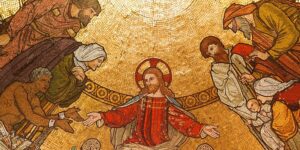
Christ the sole mediator, the Church necessary for salvation
One cannot assert that the non-Christian religions “are instruments of God’s salvation,” whereas the Declaration Dominus Iesus affirms that “one cannot overlook the fact that other rituals, insofar as they depend on superstitions or other errors (cf. 1 Cor 10:20-21), constitute an obstacle to salvation.”
Bound up with the uniqueness of the salvific mediation of Christ is the uniqueness of the Church which He founded. In effect, the Lord Jesus constituted His Church as a salvific reality: as His Body, through which He Himself acts in the history of salvation. As there is only one Christ, so there exists only one body of His: “one, holy, catholic and apostolic Church” (cf. Symbol of Faith, DS 48). The Second Vatican Council says in this regard: “the sacred Council (…), basing itself on Sacred Scripture and Tradition, teaches that this pilgrim Church is necessary for salvation” (Lumen gentium, 14).
Consequently, it would be contrary to the faith to consider the Church as one way of salvation alongside those constituted by the other religions, seen as complementary to the Church, proceeding together with her toward the eschatological kingdom of God. Thus, a certain mentality of indifferentism is to be excluded, “characterized by a religious relativism which leads to the belief that ‘one religion is as good as another’” (Redemptoris missio, 36). It is true that, as the Second Vatican Council recalled, non-Christians can “achieve” eternal salvation “with the help of grace” if they “seek God with a sincere heart” (Lumen gentium, 16). But in their sincere search for the truth of God they are in fact “ordered” to Christ and to His Body, the Church (cf. ib.). In any case, they find themselves in a deficient situation when compared with that of those who, in the Church, have the fullness of the means of salvation. Thus, understandably, following the mandate of the Lord (cf. Mt 28:19-20) and as a requirement of love for all men, the Church “announces, and is duty-bound to announce without ceasing, Christ, who is ‘the way, and the truth, and the life’ (Jn 14:6), in whom men find the fullness of religious life, in whom God has reconciled all things to Himself” (Nostra aetate, 2).
(Address of His Holiness John Paul II to the Congregation for the Doctrine of the Faith, 28/01/2000)
The Council has extensively affirmed the role of the Church for the salvation of humanity. While it acknowledges that God loves all men and grants them the possibility of being saved (cf. 1 Tim 2:4),15 the Church professes that God has constituted Christ as the one mediator and that she herself has been constituted as the universal sacrament of salvation (…) So has God willed, and for this He has established and associated the Church with His plan of salvation: “That messianic people —the Council affirms— constituted by Christ for a communion of life, charity and truth, is also used by Him as an instrument of universal redemption and is sent forth into the whole world as the light of the world and the salt of the earth”
(Redemptoris missio)
“In consequence, no human religion can guarantee us a full presence of the Spirit, nor can it claim an action of the same independent of Christ and His Church. The salvific mediations of the other religions cannot be mediations that institute alternative regimes of Christian salvation, as Dupuis maintained[134], who also comes to say that we cannot admit the universal mediation of the Church, since men are saved through other mediations. Christianity is not only the fullness of these religions but the origin of the grace that operates in them. There is no grace whatsoever, conferred by the Holy Spirit, that need not refer to Christ and to His paschal mystery, present in the Church.” (Dr. Miguel A. Barriola)
But what most draws my attention is when he says: “The other religions are also instruments of God’s salvation, because, having truths and values, according to various documents of the Church.” And that is the question I ask myself: When has the Second Vatican Council said that “the other religions are instruments of God’s salvation”? This is an INTERPRETATION of the documents of the Council.
Archbishop Ladaria mentions, in the presentation of the document of the International Theological Commission “Christianity and the Religions”, that the conciliar documents do not deal with the “value of salvation” of the non-Christian religions:
“The problem that had most occupied attention in the theology of the religions was the possible value of salvation that these might have. It is the first point studied by the Theological Commission (nn. 81-87). Neither the conciliar documents nor the encyclical Redemptoris missio had expressly pronounced on this matter, although there had been talk of the presence in cultures and religions of seeds of the Word, of rays of the truth, and also of the action of the Spirit.”
The Theological Commission (1996) was the first to raise the “value of salvation” that the religions might have. Four years later (2000) Dominus Iesus was published. According to Archbishop Ladaria, “the Commission undertook the study of this theme with the intention of exploring (…) with a clear awareness of its ambiguity for the salvation of its adherents” and that it “seeks to offer some guidelines for reflection, certainly not to give definitive solutions,” but he also mentions that “caution is likewise obliged given the ambiguity of the religious phenomenon” and that “in any case one avoids expressly identifying these elements in the religions. Only in the religion of Israel, inasmuch as the authentic divine revelation is recognized in it, can we affirm with certainty their existence.”
The Council, after having affirmed the centrality of the paschal mystery, affirms: “This holds true not only for Christians but also for all men of good will in whose hearts grace is active invisibly. For, since Christ died for all men, and since the ultimate vocation of man is in fact one, and divine, we ought to believe that the Holy Spirit in a manner known only to God offers to every man the possibility of being associated with this paschal mystery.”
(Redemptoris missio)
-“By ways that we do not know” or “in a manner known only to God”
When it is said that God gives His grace to those who are invincibly ignorant of Christ “by ways that we do not know,” this does not mean that the Catholic Church is foreign to the distribution of those graces among non-Christians. Christ and the Church form a unity, as the husband and the wife form one flesh. The salvific mediation of the Catholic Church reaches men and women beyond her visible limits.
The magisterium of the Popes has repeated that pagans can receive grace “by ways that we do not know” or “in a manner known only to God”; but, as far as I know, there is no foundation in oral and written Tradition to affirm in what manner grace is made present among the pagans—it is only said that it operates, and without knowing how…
There is a shift from a grace given “in a manner known only to God” to accepting that grace can act through the rites and customs of non-Christian religions…
Archbishop Ladaria says the following about the uniqueness of the salvific mediation of the Church:
“It is precisely this universality that leads to treating the Church as the universal sacrament of salvation (nn. 62-79). The problem is raised of whether the Church has a significance only for those who belong to her or also for the rest. Since the second answer is the one considered correct, the necessity of the Church for salvation is understood in a twofold sense: the necessity of belonging to her and the necessity of the ministry of the Church at the service of the coming of the kingdom of God. Hence this is the old question of the extra Ecclesiam nulla salus from the new perspectives opened by the Second Vatican Council, of the bond to the Church, the body of Christ, of all the justified, and above all, of the saving mission of the Church in its threefold aspect of martyría, leitourgía, and diakonía. By virtue of her testimony the Church announces the Good News to all men. In her liturgy she celebrates the paschal mystery and thus fulfills “her mission of priestly service in representation of all humanity. In a manner which, according to the will of God, is efficacious for all men, she makes present the representation of Christ who ‘was made sin for us’ (2 Cor 5:21)” (n. 77). In the service of neighbor of her diakonía she bears witness to the loving self-gift of God to men. It is clear that in pointing out these aspects of the function of the Church as the universal sacrament of salvation there was no claim to have exhausted so complex a theme.”
Cardinal Journet, in his “Conferences on Grace,” explains the salvific mediation of the Church in the following way:
“It remains for us to speak of grace as it is found in souls not moved by Christ except at a distance (…) Before His Ascension, Jesus sends the apostles into the world:
“Go ye therefore, teach ye all nations…”. You shall be witnesses unto me in Jerusalem, and in all Judea, and Samaria, and even to the uttermost part of the earth” (Acts 1, 8). “I am with you —Jesus tells them— always, even to the consummation of the world” (end of Matthew). There where the hierarchy is, with its powers of order and of jurisdiction, it will dispense the graces of contact, of which we have spoken, which will constitute the Church in her completed act. And since the disciples are sent by Christ to all nations, the Church, by right and under a normal regime, ought to exist in her full, perfect, completed form over the whole surface of the earth.
But what actually happened? The coming of Truth and of Love, in full measure, in the days of the Incarnation and of Pentecost, exasperated in refusal the forces of evil. In opposition to the evangelical forces of light and of love, the forces of error, of hatred, of falsehood coalesce, ardently disposed to wage the great battle of which the Apocalypse speaks, a battle that is to last until the end of time. What are those forces of evil? Where and in whom do they reside?
(…) The forces of evil work also, certainly, among non-Christians. When the apostles scatter throughout the world, they run into religious formations proceeding from the aberrations of paganism (…) Even today, after twenty centuries, those religious formations have not been dissolved. How many regions of Africa and of Asia that still have not been evangelized! They are blocks into which the magisterial orientation, the sap of the Sacraments, cannot penetrate, so that if grace exists in those regions, it will not be the grace of contact, sacramental and oriented, fully Christic and Christ-conforming.
Besides those unremoved blocks, from the heritage of paganism, there are others that are constituted in the course of time and that will create new obstacles to the mission of the hierarchical powers and to the diffusion of the graces of contact. Thus will appear the error of Judaism. In what does it consist? In that when the Messiah came, the Jewish people, depositary of the messianic promise, did not recognize Him. There will be, yes, a “remnant” that will make up the Church, constituted at the beginning solely by Jews, with the Virgin and the apostles; but the body of the Jewish people, because of the failure of its leaders, will not know how to see in the Gospel the fulfillment of the millenary promises made to Israel. (…)
There has been afterward the extraordinary religious formation of Islam. (…) Here again is a vast religious formation in which the mixture of great errors with great truths will constitute an obstacle to apostolic preaching. The graces of contact that she alone can procure will be discarded from the very threshold.
Later the dissidences will come. Can it be supposed, at the origin of these, that someone, the victim of an error, may nevertheless not be culpable? I believe it possible in certain circumstances; but in other cases there may be ringleaders who before God are culpable and who often appear to us as such. They are, properly speaking, the heresiarchs who knowingly break the unity of the Church and of the Christian faith. Thus are constituted new blocks that will drag along Christian truths: veneration of the Holy Scripture, validity of certain Sacraments, etc., mixed with a principle of scission. It is often said that aqua regia is the only liquid that dissolves gold; well then, the dissidences are like a mixture of gold and of aqua regia. They are the ones that, in a more or less grave manner, halt the impulse of the hierarchy: “Go ye therefore, teach ye all nations, baptizing them…”
(…) There will be need to note the advent of the atheist world. (…)
What will be the attitude of God toward the religious formations of which we have just spoken? He does not annihilate them. God is Love. He is “the true light, which enlighteneth every man.” If He mounts the cross, it is to draw all men to Himself. “God our Saviour, who will have all men to be saved, and to come to the knowledge of the truth” (1 Tim 2, 4).
Faced with the obstacles to apostolic preaching that arise on all sides, what will God do? He will open a dialogue with each of the souls that are caught in the nets of those blocks, in which truth and error, light and darkness, are seen indissolubly mixed. To supply for the graces of contact, He will send them the graces at a distance.
(…) But is it a normal regime that graces should come to men at a distance, when Christ, for two thousand years, has entrusted to His disciples the mission of going to the very extremities of the earth, solemnly promising them His assistance? No, it is abnormal that there should be upon the earth regions and souls that have not been benefited by the proclamation of the evangelical Message. That God should use a detour, that in the places where the normal graces of contact do not arrive He should send abnormal graces of supply, graces at a distance—all that attests at one and the same time the infinite desire He has of saving us and the fearsome power of evil in our world.
(…) the whole Church implores Jesus to send rays of His grace to the souls that she cannot reach. It is this that we ask when in the Pater we say fervently: “Thy kingdom come.” The Church in her completed act implores, through the holiest souls of her fold, through her liturgy and everywhere she is truly established, “for our salvation and that of the whole world” (Offertory of the Mass). Inasmuch as she cannot, she says, go to bring them the fullness of the evangelical message, go forth, O God! sending to those souls and to those regions supplementary graces. The Church, then, is not foreign to the distribution of those graces which, there where they are received, establish her in her initial, imperfect, hindered state.
The souls that accept those graces of supply will already form part spiritually of the Church, but in a manner initiated, hindered. There where a soul says a “yes” by the full acceptance of the graces at a distance, it is a Christian light that is kindled. He will still be a Buddhist or a Jew, or a Muslim, or a dissident; he will still belong corporally to the religious formations of pre-Christian times, but he will already belong spiritually to the Church. And he will begin, unconsciously perhaps, to influence his milieu in order to modify it; he will spontaneously insist on all that he possesses of the authentic and will detach himself little by little from the rest.”
Saint Paul compares the marital relationship with the spousal communion that exists between Christ and the Church (“For this cause shall a man leave his father and mother, and shall cleave to his wife, and they shall be two in one flesh. This is a great sacrament; but I speak in Christ and in the church” Eph 5, 31-32). “The great mystery is, then, the union of Christ and of the Church, described with the very terms with which Gen. 2, 24 describes the union of man and woman. The mystery consists in that Christ and the Church form a unity, as the husband and the wife form one flesh. This mystery was hidden for centuries, but now, after the glorification of Christ, it has been revealed to the prophets of the new covenant, and for this reason Paul can found upon this marital union of Christ and His Church the morals of the married” (Sacred Scripture—commentary by Professors of the Society of Jesus, B.A.C., 1965).
We do not defend an ecclesiocentrism that feels fear of losing power (which, by the way, is practically nonexistent in these times), but rather the marital union between Christ and His Church.
In Nostra Aetate one reads the following: “The Catholic Church rejects nothing of what is true and holy in these religions. She regards with sincere respect those ways of acting and of living, those precepts and doctrines which, though differing in many points from that which she herself holds and sets forth, nonetheless often reflect a ray of that truth which enlightens all men and women.”
In the Encyclical Evangelii Praecones (June 2, 1951), of Pius XII, it is said that the “Catholic Church has neither scorned nor rejected the pagan philosophies but instead has freed them from all error and impurity, and has consummated and perfected them with Christian wisdom.”
If we recognize some virtue in our neighbor, this does not annul his evident errors. Judaism venerates the Sacred Scriptures—they call it Tanakh and we the Old Testament. That recognition does not annul the fact that they have rejected the Messiah and that one day—according to Saint Paul—they will be converted to Christ and will become part of the Church.
But one thing does not take away the other; the erroneous is mixed with the good. What is erroneous in every religion and culture is to be rejected, and what is good is to be praised and respected. In our very living of the faith so many imperfections are embedded, which the Church patiently polishes throughout her tradition. Even so, it must be possible to arrive at a “criterion” that enables one to hit upon what is universally valid and likewise what is to be discarded for all.
Hence, too, the serious warnings against a flabby tolerance, a poorly enlightened syncretism, and an indifferentism for which the pearl and the dung would be worth just the same. For this reason, in a balanced way Dominus Iesus, 22, continues to recall: “With the coming of the Saviour Jesus Christ, God has willed that the Church founded by Him be the instrument for the salvation of all humanity (cf. Acts 17:30-31). This truth of faith does not lessen the sincere respect which the Church has for the religions of the world, but at the same time, it rules out, in a radical way, that mentality of indifferentism ‘characterized by a religious relativism which leads to the belief that one religion is as good as another’”[127]. If it is true that the followers of other religions can receive divine grace, it is also certain that objectively speaking they are in a gravely deficient situation in comparison with those who, in the Church, have the fullness of the means of salvation[128].
(Dr. Miguel A. Barriola)
There is confusion of terms
– ‘Invincible ignorance’ is exalted as a good
It is true that invincible ignorance renders the act inculpable and that there is no sin from the moral point of view, but the person does not improve, does not acquire virtues, is less perfect. A person who has not learned to read bears no fault, but he does not know how to read, and he does not attain many human perfections. Thus it happens in every art (painting, singing, reciting, etc.), and of course in morals (loyalty, kindness, elegance, courtesy, fortitude, chastity, responsibility, sincerity, simplicity, magnanimity, and all the human graces). (Fr. Enrique Cases).
– The fatal consequences of ‘vincible ignorance’ are totally ignored
Not all who are ignorant of Christ suffer from invincible ignorance; there are also those who suffer from vincible ignorance and, therefore, are responsible and culpable for their rejection of Christ. As for the person who suffers from vincible ignorance and finds himself in a religion that tells him that ‘Jesus is not God and is not the only saviour of man,’ if he is cheerfully told that his religion is an “instrument of salvation,” we would be reaffirming his error and would even make ourselves responsible for his condemnation.
– Is it enough to be good in order to be saved?
It is taught that having been born into this or that religious tradition is merely accidental, and that therefore, in order to be saved, it makes no difference which religion you profess, provided you are good.
This apparently self-evident proposition permits some conclusions. It shows, indeed, to what extent the widespread opinion is false, according to which each one must live according to his conviction and will be saved by reason of his fidelity to his conscience. In what manner? Could the heroism of the SS man, the cruel precision of his perverted obedience, be a kind of votum ecclesiae? Never!
But this extreme example brings to light the whole problematic of this opinion and of its point of departure. For, identifying the cry of conscience with the conviction of each one, which engenders a social and historical status, such a thesis leads to the conception according to which a man is saved each time that, through the conscientious application of the system in which he finds himself or to which he has bound himself. Conscience degenerates into scrupulous adhesion to its ideas; the system in each case comes to be «the way of salvation». The impression is given of being humane and merciful when it is said, starting from that position, that a Muslim must, in order to be saved, be «a good Muslim» (What does this mean exactly?), a Hindu be a good Hindu, etc.[123]. But then, must one not say that a cannibal must be a «good cannibal» and a convinced SS man be a complete SS man? Evidently something is amiss; a «theology of the religions» that has developed from such premises leads necessarily to a blind alley… It is only in appearance that such theses (that a Muslim should be a good Muslim…) are «progressive»; in reality, they exalt conservatism to the height of a worldview: each one would arrive at salvation by his own system[124]… If the religions and the systems as such were to save man, were to constitute for him the way of salvation, humanity would remain eternally shut up within its particularisms. Faith in Christ signifies, on the contrary, the conviction that there exists a call to the overcoming of these particularisms and that only thus, in the march toward the unity of the spirit, does history move toward its fulfillment”[125]. (Dr. Miguel A. Barriola)
Nowadays the theologian is held to be a “master of the faith,” supplanting the role that belongs to the bishops. It suffices for one to publish a book for others to accept his teachings without distinguishing between Catholic doctrine, a document that explores a theme without the intention of defining, and a personal interpretation.
– A commentary from CICLA – Interprovincial Claretian Confederation of Latin America and the Caribbean
“At times we jealously think that we are the exclusive possessors, the proprietors of salvation.”
– A commentary on the site of the Episcopal Vicariate of Pastoral Ministry of the Archdiocese of Mexico:
“The religion we have often does not depend on us, but rather is a consequence of having been born in one place or another, in a family that has such a concrete religion. For this reason our salvation does not depend on the religion we profess, but on our being good; so that all those who sincerely live their religion, God will save. But it is also true that being in the true religion, as we Catholics are, helps us greatly. It is like an athlete who has the best trainer and the appropriate training; that athlete has the best resources to triumph.
http://www.vicariadepastoral.org.mx/proyectos/jesucristo/jesucristo_05.htm
Despite the recommendation of caution by Archbishop Ladaria—and the fact that only in the religion of Israel, inasmuch as the authentic divine revelation is recognized in it, can we affirm with certainty the existence of a salvific value; despite all the clarifications, especially Dominus Iesus, there is an increase in the diffusion of “religious pluralism” that promotes a decided rejection of “ecclesiocentrism,” which translates into a rejection of the salvific mediation of the Church and of Christianity and which leads to religious indifferentism.
Author: Beatriz Aparicio
