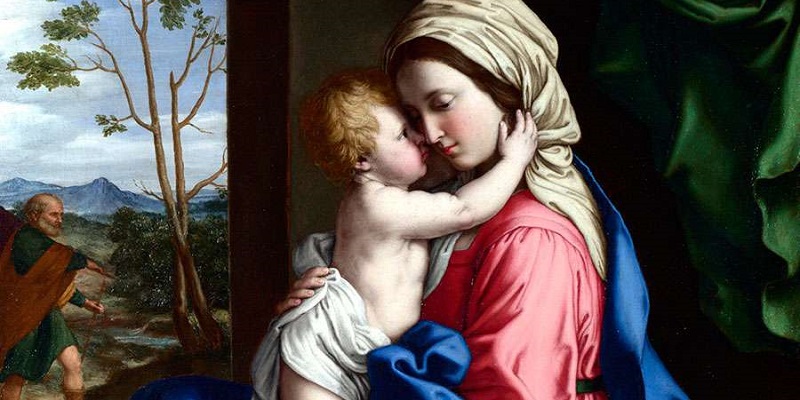
1. “The books of the Old Testament describe the history of salvation in which the coming of Christ into the world is prepared step by step. These earliest documents, as they are read in the Church and understood in the light of a further and full revelation, bring the figure of the woman, Mother of the Redeemer, into a gradually clearer light” (Lumen gentium, 55).
With these affirmations, the Second Vatican Council reminds us how the figure of Mary was gradually outlined from the beginnings of salvation history. She is already glimpsed in the texts of the Old Testament, but she is fully understood only when those texts are read in the Church and understood in the light of the New Testament.
Indeed, the Holy Spirit, by inspiring the various human authors, oriented Old Testament Revelation toward Christ, who would become incarnate in the womb of the Virgin Mary.
2. Among the biblical words that foretold the Mother of the Redeemer, the Council cites first of all those with which God, after the fall of Adam and Eve, reveals his plan of salvation. The Lord says to the serpent, figure of the spirit of evil: “I will put enmity between you and the woman, and between your offspring and her offspring: he shall bruise your head while you lie in wait for his heel” (Gen 3:15).
These expressions, called by Christian tradition since the sixteenth century the Protoevangelium, that is, the first good news, allow us to perceive God’s saving will already from the origins of humanity. Indeed, in the face of sin, according to the account of the sacred author, the Lord’s first reaction did not consist in punishing the guilty, but in opening for them a perspective of salvation and actively involving them in the work of redemption, showing his great generosity even toward those who had offended him.
The words of the Protoevangelium also reveal the singular destiny of the woman who, although she preceded the man in yielding to the temptation of the serpent, later becomes, by virtue of the divine plan, God’s first ally. Eve was the ally of the serpent in drawing man into sin. God announces that, reversing this situation, he will make the woman the enemy of the serpent.
3. Exegetes agree in recognizing that the text of Genesis, according to the Hebrew original, does not directly attribute the action against the serpent to the woman, but to her offspring. Nevertheless, the text gives great prominence to the role she will play in the struggle against the tempter: her offspring will be the victor over the serpent.
Who is this woman? The biblical text does not give her personal name, but it allows us to glimpse a new woman, willed by God to repair Eve’s fall: she is called to restore the role and dignity of woman and to contribute to the change of humanity’s destiny, collaborating through her maternal mission in the divine victory over Satan.
4. In the light of the New Testament and of the tradition of the Church, we know that the new woman announced by the Protoevangelium is Mary, and we recognize in “her offspring” (Gen 3:15), her Son, Jesus, who triumphs in the mystery of Easter over the power of Satan.
Let us also observe that the enmity placed by God between the serpent and the woman is realized in Mary in two ways. She, the perfect ally of God and enemy of the devil, was completely freed from Satan’s dominion in her Immaculate Conception, when she was fashioned in grace by the Holy Spirit and preserved from every stain of sin. Moreover, Mary, associated with the saving work of her Son, was fully committed in the struggle against the spirit of evil.
Thus, the titles of Immaculate Conception and Cooperator of the Redeemer, which the faith of the Church has attributed to Mary in order to proclaim her spiritual beauty and her intimate participation in the admirable work of Redemption, manifest the irreducible opposition between the serpent and the new Eve.
5. Exegetes and theologians consider that the light of the new Eve, Mary, from the pages of Genesis is projected over the whole economy of salvation, and they already see in this text the bond that exists between Mary and the Church. Let us note here with joy that the term woman, used in a generic form by the text of Genesis, encourages us to associate with the Virgin of Nazareth and her task in the work of salvation especially women, called, according to the divine plan, to commit themselves to the struggle against the spirit of evil.
Women who, like Eve, could yield to the seduction of Satan, through solidarity with Mary receive a superior strength to fight the enemy, becoming God’s first allies on the path of salvation.
This mysterious alliance of God with woman is manifested in many forms also in our own day: in women’s assiduity in personal prayer and liturgical worship, in service to catechesis and in the witness of charity, in the many female vocations to the consecrated life, in religious education within the family…
All these signs constitute a very concrete realization of the oracle of the Protoevangelium, which, suggesting a universal extension of the word woman, within and beyond the visible boundaries of the Church, shows that Mary’s unique vocation is inseparable from the vocation of humanity and, in particular, from that of every woman, which is illumined by the mission of Mary, proclaimed the first ally of God against Satan and evil.
Author: His Holiness John Paul II
Source: L’Osservatore Romano, weekly edition in Spanish, 26-I-96]
