The Shepherd of Hermas
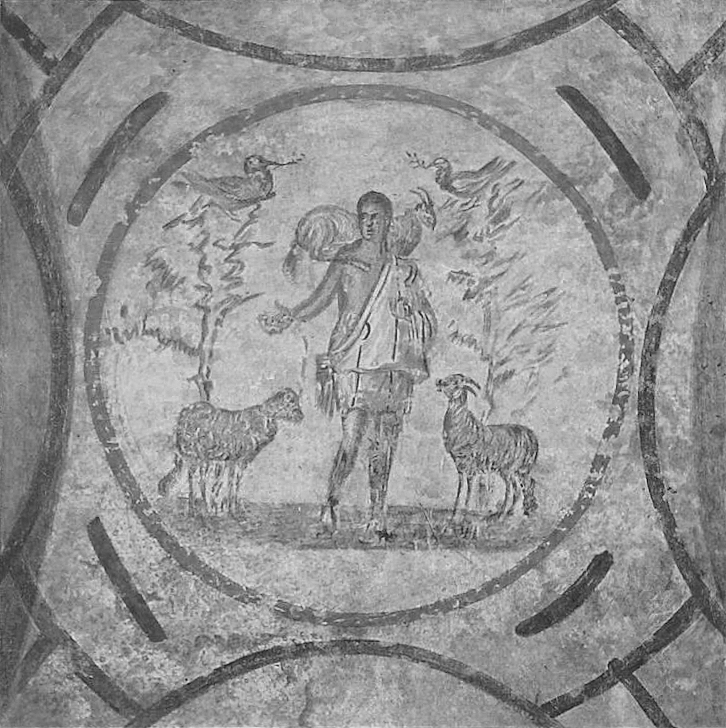
The Good Shepherd, fresco from the Roman catacombs (3rd century)
The Shepherd of Hermas is one of the most popular works of early Christianity and one of the most widely read outside the canon of the New Testament. Written in Rome in the second century, it was for a long time considered an almost canonical text by various Christian communities, and the historian Eusebius of Caesarea includes it among the disputed books. Its author, known as Hermas, was a freedman of Rome who describes in the work a series of visions, mandates, and similitudes received from two heavenly figures: an old woman representing the Church, and an angel in the form of a shepherd embodying the spirit of penance. Precisely because of its emphasis on conversion, penance, and moral purity, The Shepherd is of exceptional value for understanding the faith and practice of the first Christians in the matters that Protestantism most disputes.
The Pre-existence of the Church
One of the most characteristic affirmations of The Shepherd of Hermas concerns the nature and antiquity of the Church. In the second vision, Hermas receives from the old woman — the figure who represents the Church — a revelation about her origin that is of enormous apologetic importance. To the question of why the Church appears to him under the form of an aged woman, the answer is one of unequivocal directness:
“Because she was created the first of all things. For this reason is she old, and for her sake was the world made.” (The Shepherd of Hermas, Vision 2:4:1)
For the first Christians, the Church was not a human institution that had come into existence at a particular moment in history as a result of the religious needs of men. It was, on the contrary, the most ancient reality of creation — the very thing for which the world itself was made. This conviction stands in radical contrast to the Protestant view of the Church, which in its various forms tends to conceive of it as a merely historical reality, variable in form and never fully identifiable with any concrete ecclesial institution.
This pre-existence of the Church is visualized in a particularly eloquent manner in the great vision of the tower that forms the center of the work. A tower is built upon the waters, and the material from which it is constructed consists of stones representing baptized believers. When Hermas asks the old woman the meaning of the vision, she replies:
“The tower which you see building, am I, the Church, who appeared to you now and on the former occasion.” (The Shepherd of Hermas, Vision 3:3:3)
“Why is the tower built upon the waters? — Because your life has been, and will be, saved through water; and the foundation of the tower is the Word of the all-powerful and glorious Name, and it is kept together by the invisible power of the Lord.” (The Shepherd of Hermas, Vision 3:3:5)
The image of the Church built upon the water is a transparent allusion to baptism as the gateway into the Church. The faithful are the stones of the building, and this building — the Church — is the visible realization in history of the eternal design of God. Behind the image lies a robust ecclesiology: the Church is one, holy, and governed by legitimate authority; and the unity of the Church is a necessary condition for salvation. There is no place in this vision for a plurality of equally valid churches, as Protestantism in all its branches supposes.
The Second Penance and Confession
The central theological theme of The Shepherd of Hermas is the doctrine of penance. The entire work is, in a certain sense, a treatise on the mercy of God and the possibility of conversion for those who have sinned after baptism. This teaching is of particular importance in the context of the debate with Protestantism, given that the reformers rejected the Sacrament of Penance as an institution of the Church, replacing it with the conviction that the Christian can obtain forgiveness of sins directly from God through an interior act of faith and contrition, without any need of ecclesiastical mediation.
|
From the author The Church Fathers speak for themselvesThis article is part of Early Christianity: In Search of the Origins of the Catholic Church, a documented journey through the faith of the first centuries and its answers to the questions that still divide Catholics and Protestants. |
 |
The first Christians thought in a radically different way, as the testimony of Hermas proves. The angel-shepherd, the central figure of the work, instructs Hermas on the existence of a second penance subsequent to baptism and on the conditions necessary to obtain forgiveness of sins committed after receiving baptismal grace. The doctrine set forth is unequivocally ecclesial: it is not a matter of a purely private reconciliation between the soul and God, but of a process of conversion that takes place within the community of the Church, mediated by the authority of the spirit of penance:
“Sir, I heard from some teachers that there is no other repentance than that which takes place when we descended into the water and received remission of our former sins. He said to me: That was sound doctrine which you heard; for that is really the case. For he who has received remission of his sins ought not to sin any more, but to dwell in purity. Since, however, you inquire diligently into all things, I will point this also out to you, not as giving occasion for error to those who are to believe, or have lately believed, in the Lord. For those who have now believed, and those who are to believe, have not repentance for their sins; but they have remission of their previous sins. For to those who have been called before these days, the Lord has set repentance. For the Lord, knowing the heart, and foreknowing all things, knew the weakness of men and the manifold wiles of the devil, that he would inflict some evil on the servants of God, and would act wickedly toward them. The Lord, therefore, being merciful, has had mercy on the work of His hand, and has set up this repentance, and to me has been given authority over this repentance. But I say unto you, if after that great and holy calling any one, being tempted by the devil, has committed sin, he has only one repentance.” (The Shepherd of Hermas, Mandate 4:3:1–3)
The doctrinal content of this passage is of notable richness. First, Hermas teaches that baptism forgives all prior sins and that the baptized Christian should not sin again. Second, he recognizes that, given human weakness and the cunning of the devil, God has established a second opportunity for penance for the baptized who have fallen into sin. Third — and this is crucial — this second penance is directly linked to the “angel of penance,” that is, to a figure of spiritual authority who mediates and administers it. The structure is exactly the same as that of the Sacrament of Penance as taught by the Catholic Church.
One might also ask: would Hermas’s doctrine on penance not be that which the Protestants themselves would defend? Would a sincere interior act of contrition not suffice to obtain forgiveness? The answer The Shepherd gives is clear: penance is not a purely interior and private matter. The penitent must manifest his conversion, submit to the spiritual guidance of the angel-shepherd, and reintegrate his life of moral purity within the Church. Ecclesial mediation is not a later addition to primitive Christian faith: it is the very manner in which God, from the earliest centuries, has willed to dispense His mercy to sinners.
Baptism as the Seal of Life
In Similitude 9, one of the most extensive and theologically rich parables in the entire work, The Shepherd of Hermas sets forth with notable clarity the doctrine on baptism and its necessity for salvation. The text describes the vision of an enormous tower with a single great gate; to enter it — the Church — one must pass through that gate, which represents baptism. The explanation offered by the angel leaves no room for spiritualist interpretations that would reduce baptism to a mere outward symbol of an already existing faith:
“Before a man bears the name of the Son of God, he is dead; but when he receives the seal he lays aside his deadness, and obtains life. The seal, then, is the water: they descend into the water dead, and they arise alive. And to them, accordingly, was this seal preached, and they made use of it that they might enter into the kingdom of God.” (The Shepherd of Hermas, Similitude 9:16:2–4)
The clarity of this text could scarcely be greater. Before baptism, the man is spiritually dead; after baptism, he lives. The water is the seal by which man passes from death to life. This is the primitive Christian faith on baptism, shared without exception by all the Apostolic Fathers: baptism is not a symbol or a public declaration of an already existing faith, as many Protestant traditions teach, but the efficacious sacrament by which God communicates His life to man and incorporates him into the Church.
The testimony of Hermas closes the circle of baptismal faith that we have encountered throughout all the apostolic writings: from the Didache, which regulates the modalities of baptism in notable detail, to Saint Ignatius, who unhesitatingly identifies baptism with entry into the Church; from Saint Clement, who links it to apostolic succession, to Hermas himself, who describes it as the seal of divine life. In none of these texts does the Protestant doctrine of “faith alone” appear as a sufficient and autonomous principle of salvation; in all of them, baptismal faith and membership in the community of the Church are inseparable.
